Q63 / 150 · MHT CET 2026 (19 April Shift 1) · Mathematics
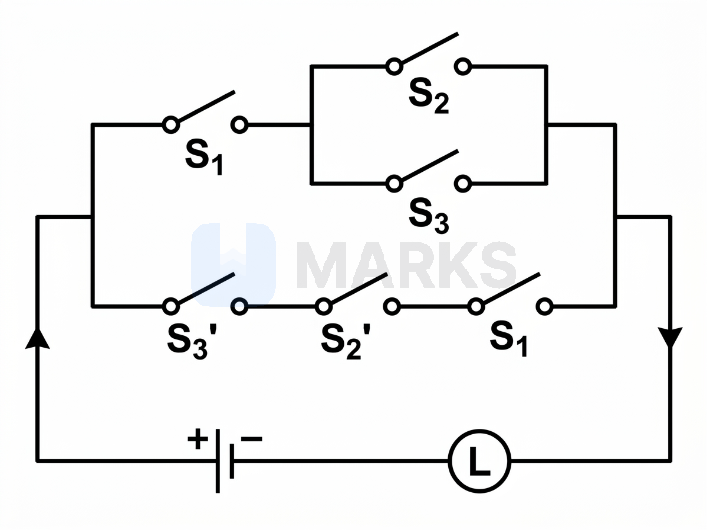
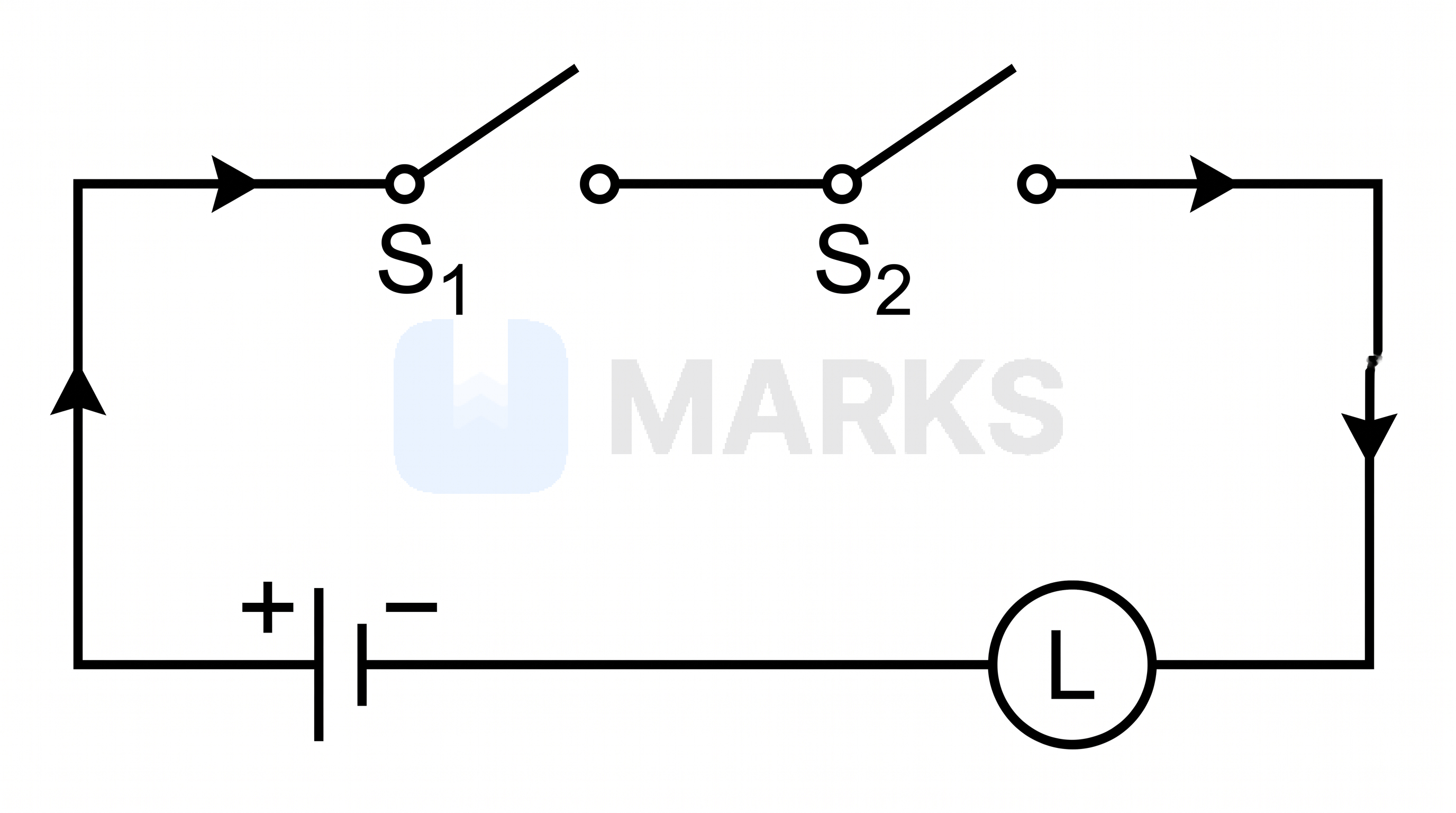
The simplified switching circuit for the following circuit is
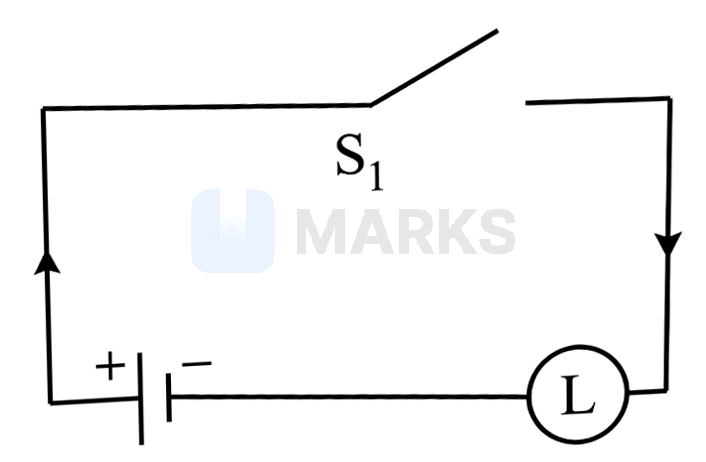
- Correct answerA
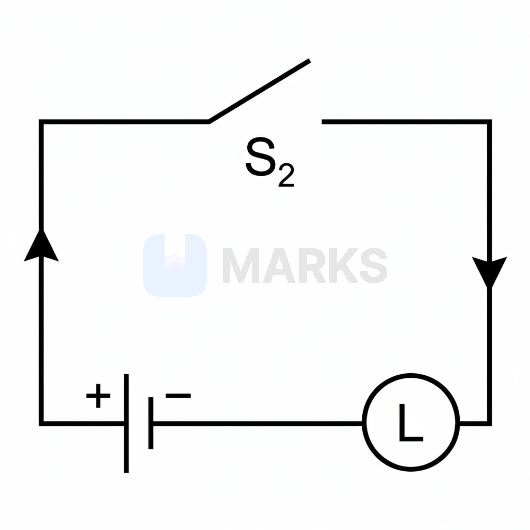
- B
- C
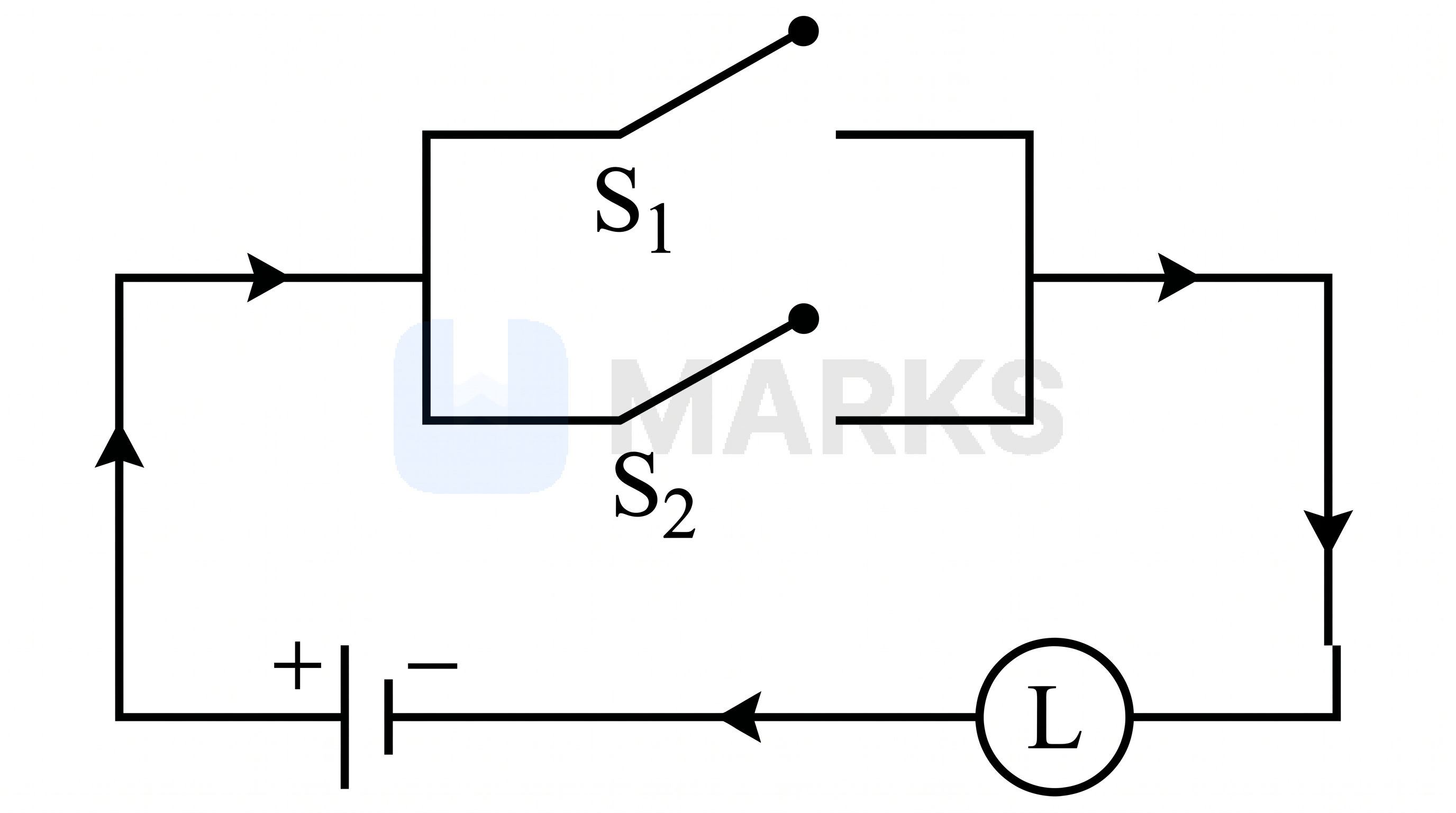
- D
Solution
Let $p, q, r$ represent the switches $S_1, S_2, S_3$ respectively.
The Boolean expression for the top branch is $p \wedge (q \vee r)$.
The Boolean expression for the bottom branch is $\sim r \wedge \sim q \wedge p$, which can be rewritten as $p \wedge (\sim q \wedge \sim r)$.
The total circuit is the parallel combination of these two branches, so the expression is:
$[p \wedge (q \vee r)] \vee [p \wedge (\sim q \wedge \sim r)]$
Using De Morgan's Law, $\sim q \wedge \sim r \equiv \sim(q \vee r)$.
Substituting this, we get:
$[p \wedge (q \vee r)] \vee [p \wedge \sim(q \vee r)]$
Using the distributive law, we can factor out $p$:
$p \wedge [(q \vee r) \vee \sim(q \vee r)]$
Since $A \vee \sim A \equiv T$ (where $T$ represents a closed circuit or tautology), we have:
$p \wedge T \equiv p$
This means the simplified circuit consists only of the switch $S_1$.
Answer:
Hence, the correct answer is option: 'A'.