Q36 / 160 · JIPMER 2014 · Chemistry
The relative reactivities of acyl compounds towards nucleophilic substitution are in the order of
- Correct answerAacyl chloride $\gt$ acid anhydride $\gt$ ester $\gt$ amide
- Bester $\gt$ acyl chloride $\gt$ amide $\gt$ acid anhydride
- Cacid anhydride $\gt$ amide $\gt$ ester $\gt$ acyl chloride
- Dacyl chloride $\gt$ ester $\gt$ acid anhydride $\gt$ amide
Solution
The ease of nucleophilic substitution is depend upon the nature of leaving group. When the leaving tendency of a group in a compound is high, then the compound is more reactive towards nucleophilic substitution.
The nucleophilic acyl substitution is completed in two steps as shown below
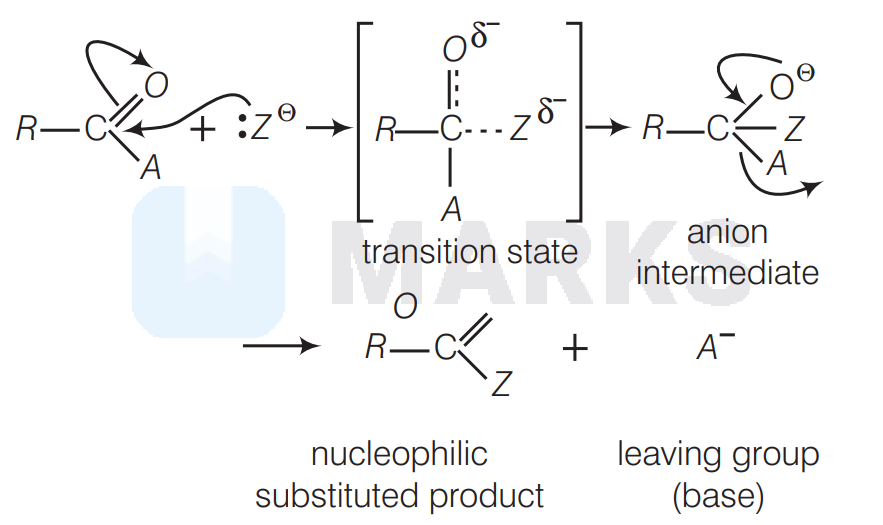 The reactivity of the compound may be explained on the basicity of the leaving group. A weaker base is a better leaving group. The basicity order is as
$\mathrm{Cl}^{-}\gt\mathrm{RCOO}^{-}\gt\mathrm{RO}^{-}\gt\mathrm{NH}_2^{-}$
Hence, the order of the leaving tendency is
$\mathrm{Cl}^{-}\gt\mathrm{RCOO}^{-}\gt\mathrm{R}-\mathrm{O}^{-}\gt\mathrm{NH}_2^{-}$
and therefore, the order of reactivity of acyl compound is as
 Acyl chloride $\gt$ Acid anhydride $\gt$ Ester $\gt$ Amide
The reactivity of the compound may be explained on the basicity of the leaving group. A weaker base is a better leaving group. The basicity order is as
$\mathrm{Cl}^{-}\gt\mathrm{RCOO}^{-}\gt\mathrm{RO}^{-}\gt\mathrm{NH}_2^{-}$
Hence, the order of the leaving tendency is
$\mathrm{Cl}^{-}\gt\mathrm{RCOO}^{-}\gt\mathrm{R}-\mathrm{O}^{-}\gt\mathrm{NH}_2^{-}$
and therefore, the order of reactivity of acyl compound is as
Acyl chloride $\gt$ Acid anhydride $\gt$ Ester $\gt$ AmideHence, the correct answer is option: 'A'.