Q129 / 180 · COMEDK 2025 (10 May Shift 3) · Physics
The power dissipated across the $16 \Omega$ resistor in the circuit is 2 watts. The power dissipated in watt units across the $4 \Omega$ resistor is:
- A4.28 W
- B0.64 W
- C2.38 W
- Correct answerD1.28 W
Solution
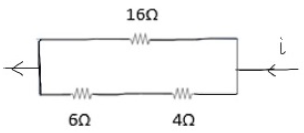
The circuit consists of two parallel branches. The top branch contains a $16 \Omega$ resistor. The bottom branch contains a $6 \Omega$ resistor and a $4 \Omega$ resistor in series.
Let $V$ be the potential difference across the parallel branches. The power dissipated in the $16 \Omega$ resistor is given by $P_{16} = \dfrac{V^2}{R_{16}} = 2$ W. Substituting $R_{16} = 16 \Omega$, we get $\dfrac{V^2}{16} = 2$, which implies $V^2 = 32$ V$^2$.
The bottom branch has a total resistance $R_{bottom} = 6 \Omega + 4 \Omega = 10 \Omega$. The current flowing through the bottom branch is $I_{bottom} = \dfrac{V}{R_{bottom}} = \dfrac{V}{10}$.
The power dissipated in the $4 \Omega$ resistor is $P_4 = I_{bottom}^2 \times R_4 = \left(\dfrac{V}{10}\right)^2 \times 4 = \dfrac{V^2}{100} \times 4$.
Substituting $V^2 = 32$, we get $P_4 = \dfrac{32}{100} \times 4 = \dfrac{128}{100} = 1.28$ W.
Answer: 1.28 W
Hence, the correct answer is option: 'D'.