Q110 / 150 · MHT CET 2026 (18 April Shift 1) · Physics
The point charges $+q$, $-q$, $-q$, $+q$, $+Q$ and $-q$ are placed at the vertices of a regular hexagon ABCDEF as shown in the figure.
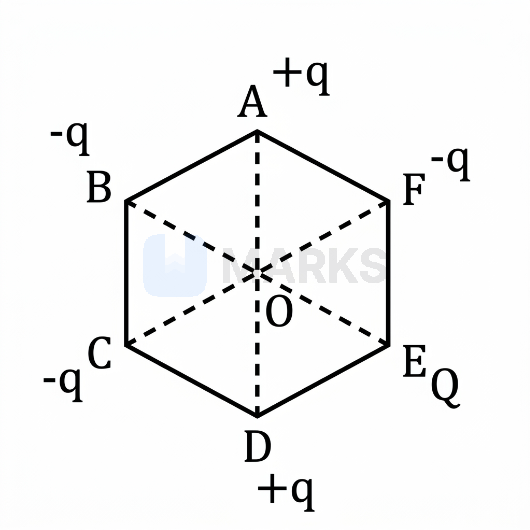
The electric field at the centre of the hexagon 'O' due to the five charges at A, B, C, D and F is thrice the electric field at centre 'O' due to charge $+Q$ at E alone. The value of Q is
The electric field at the centre of the hexagon 'O' due to the five charges at A, B, C, D and F is thrice the electric field at centre 'O' due to charge $+Q$ at E alone. The value of Q is
- Correct answerA$\dfrac{q}{3}$
- B$\dfrac{q}{4}$
- C$3q$
- D$4q$
Solution
Let the distance from each vertex of the regular hexagon to its center O be $r$.
The electric field at the center O due to a point charge $q$ at a distance $r$ has a magnitude $E = \dfrac{1}{4\pi\epsilon_0}\dfrac{q}{r^2}$.
In the regular hexagon ABCDEF, the pairs of diametrically opposite vertices are (A, D), (B, E), and (C, F).
The charges at A and D are both $+q$. The electric fields produced by these two charges at the center O are equal in magnitude and opposite in direction, thus they cancel each other out.
The charges at C and F are both $-q$. The electric fields produced by these two charges at O are equal in magnitude and opposite in direction (pointing towards C and F respectively), thus they also cancel each other out.
Therefore, the net electric field at the center O due to the five charges at A, B, C, D, and F is solely the electric field produced by the charge $-q$ at B.
The magnitude of this field is $E_1 = \dfrac{1}{4\pi\epsilon_0}\dfrac{q}{r^2}$.
The electric field at O due to the charge $+Q$ at E alone has a magnitude $E_2 = \dfrac{1}{4\pi\epsilon_0}\dfrac{Q}{r^2}$.
According to the given condition, $E_1 = 3E_2$.
$\dfrac{1}{4\pi\epsilon_0}\dfrac{q}{r^2} = 3 \left(\dfrac{1}{4\pi\epsilon_0}\dfrac{Q}{r^2}\right)$
$q = 3Q$
$Q = \dfrac{q}{3}$
Hence, the correct answer is option: 'A'.