Q115 / 180 · AIIMS 2003 · Physics
The motion of planets in the solar system is an example of the conservation of
- Amass
- Blinear momentum
- Correct answerCangular momentum
- Denergy.
Solution
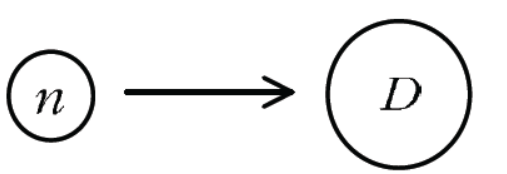
One deuteron consists of one proton and one neutron. As the mass of a proton and a neutron is approximately same $\left(\approx 1.67 \times 10^{-27} \mathrm{~kg}\right)$, we assume that the mass of the neutron be $m$ and the mass of the deuteron be $2 m$ as the electron mass is negligibly small compared to that of proton and neutron. Let the initial velocity of the neutron be $u$. As the deuteron is initially at rest, the final velocity of the neutron is $$ v_1=\left(\frac{m-2 m}{m+2 m}\right) u=-\frac{m u}{3 m}=-\frac{u}{3} . $$ and the velocity of the deuteron is $$ v_2=\frac{2 m}{m+2 m} u=\frac{2}{3} u \text {. } $$ Total energy before collision is $E_1=\frac{1}{2} m u^2$ After collision, the energy gained by the deuteron is $$ E_d=\frac{1}{2} \times(2 m) v_2^2=m \times\left(\frac{2}{3} u\right)^2=\frac{4}{9} m u^2 . $$ $E_d$ is the amount of energy lost by the neutron. Therefore the fractional loss of energy of the neutron is $$ \frac{E_d}{E_1}=\frac{(4 / 9) m u^2}{(1 / 2) m u^2}=\frac{8}{9} $$
Hence, the correct answer is option: 'C'.