Q76 / 150 · MHT CET 2024 (09 May Shift 1) · Mathematics
The maximum value of $\mathrm{z}=x+y$, subjected to $x+y \leq 10,5 x+3 y \geq 15, x \leq 6, x, y \geq 0$
- Aoccurs only at unique point.
- Boccurs only at two distinct points.
- Correct answerCoccurs at infinitely many points.
- Ddoes not exist.
Solution
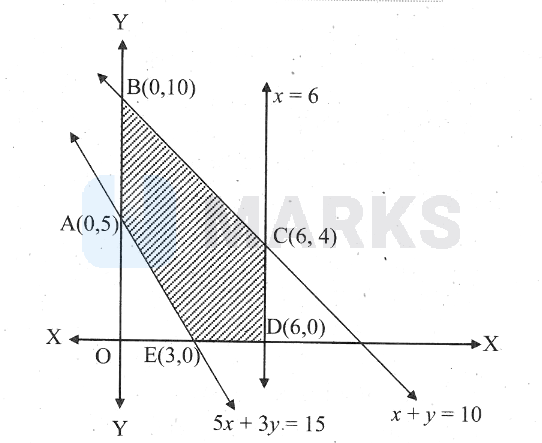
Feasible region lies on the origin side of $x+y=10, x=6$ and non-origin side of $5 x+3 y=15$ The corner points of feasible region are $\mathrm{A}(0,5)$ and $(0,10), \mathrm{C}(6,4), \dot{D}(6,0), \mathrm{E}(3,0)$ At A(0,5), z = 0+5=5 At $B(0,10), z=0+10=10$ At C(6,4), $z=6+4=10$ At $\mathrm{D}(6,0), \mathrm{z}=6+0=6$ At $\mathrm{E}(3,0), \mathrm{z}=3+0=3$ $\therefore \quad z$ has maximum value at $\mathrm{B}(0,10)$ and $C(6,4)$. $\therefore \quad z$ has infinite solution on seg BC.
Hence, the correct answer is option: 'C'.