Q124 / 180 · COMEDK 2014 · Physics
The maximum and minimum distances of a comet from the sun are $1.4 \times 10^{12} \mathrm{~m}$ and $7 \times 10^{10} \mathrm{~m}$. If its velocity nearest to the sun is $6 \times 10^{14} \mathrm{~ms}^{-1}$, what is its velocity in the farthest position?
(Assume the comet to be spherical)
- Correct answerA$3 \times \mathrm{10}^{-18} \quad$
- B$2 \times \mathrm{10}^{-18} \quad$
- C$\mathrm{10}^{-18} \quad$
- D$4 \times \mathrm{10}^{-18} \quad$
Solution
The given situation is shown below
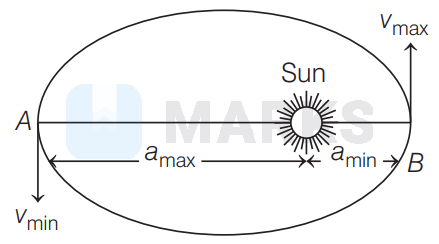
$a_{\max }=1.4 \times 10^{12} \mathrm{~m}$ $a_{\min }=7 \times 10^{10} \mathrm{~m}$ The velocity of the comet is maximum, when it is nearest to the sun and minimum when it is farthest from the sun. $\therefore \quad v_{\max }=6 \times 10^{14} \mathrm{~m} / \mathrm{s}$ Applying the law of conservation of angular momentum at points $A$ and $B$, we get $$ \begin{aligned} &m v_{\min } a_{\max }=m v_{\max } a_{\min } \quad(\quad L=m v r) \\ &\Rightarrow \quad v_{\min }=\frac{v_{\max } \times a_{\min }}{a_{\max }} \\ &=\frac{6 \times 10^{14} \times 7 \times 10^{10}}{1.4 \times 10^{12}} \\ &=3 \times 10^{13} \mathrm{~ms}^{-1} \end{aligned} $$ No option is correct.
$a_{\max }=1.4 \times 10^{12} \mathrm{~m}$ $a_{\min }=7 \times 10^{10} \mathrm{~m}$ The velocity of the comet is maximum, when it is nearest to the sun and minimum when it is farthest from the sun. $\therefore \quad v_{\max }=6 \times 10^{14} \mathrm{~m} / \mathrm{s}$ Applying the law of conservation of angular momentum at points $A$ and $B$, we get $$ \begin{aligned} &m v_{\min } a_{\max }=m v_{\max } a_{\min } \quad(\quad L=m v r) \\ &\Rightarrow \quad v_{\min }=\frac{v_{\max } \times a_{\min }}{a_{\max }} \\ &=\frac{6 \times 10^{14} \times 7 \times 10^{10}}{1.4 \times 10^{12}} \\ &=3 \times 10^{13} \mathrm{~ms}^{-1} \end{aligned} $$ No option is correct.
Hence, the correct answer is option: 'A'.