Q53 / 180 · COMEDK 2025 (25 May Shift) · Chemistry
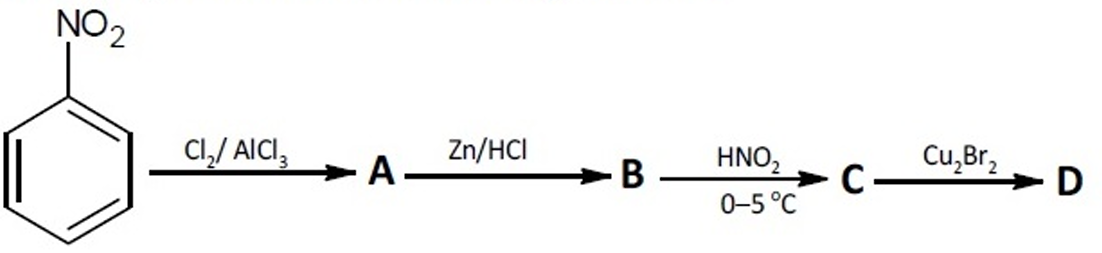
The major product ' $D$ ' of the following reaction is:
- A3-bromobenzenediazoniumchloride
- B3-bromo-5-chloroaniline
- CBromobenzene
- Correct answerD1-bromo-3-chlorobenzene
Solution
The starting material is nitrobenzene. Nitrobenzene undergoes electrophilic aromatic substitution with $Cl_{2}/AlCl_{3}$. Since the $-NO_{2}$ group is meta-directing, the chlorine atom enters the meta position, forming A, which is 1-chloro-3-nitrobenzene.
In the next step, A (1-chloro-3-nitrobenzene) is treated with $Zn/HCl$, which is a reducing agent. This reduces the nitro group ($-NO_{2}$) to an amino group ($-NH_{2}$), resulting in B, which is 3-chloroaniline.
Next, B (3-chloroaniline) is treated with $HNO_{2}$ at $0-5^{\circ}C$. This is a diazotization reaction, which converts the amino group into a diazonium salt, forming C, which is 3-chlorobenzenediazonium chloride.
Finally, C (3-chlorobenzenediazonium chloride) is treated with $Cu_{2}Br_{2}$ (or $CuBr/HBr$), which is a Sandmeyer reaction. This replaces the diazonium group ($-N_{2}^{+}Cl^{-}$) with a bromine atom, resulting in D, which is 1-bromo-3-chlorobenzene.
Answer: 1-bromo-3-chlorobenzene
Hence, the correct answer is option: 'D'.