Q28 / 110 · VITEEE 2024 · Chemistry
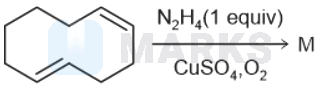
The major product M formed in the following reaction is
- A
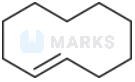
- Correct answerB
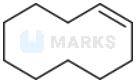
- C
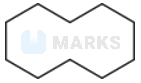
- D
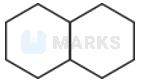
Solution
Concept:-
Reductions with diimide:
- Isolated carbon-carbon double bonds can be reduced with hydrazine \(\left(\mathrm{NH}_2 \mathrm{NH}_2\right)\) in the presence of oxygen or an oxidizing agent.
- The actual reducing agent in these reactions is the highly active species diimide, \(\mathrm{HN}=\mathrm{NH}\), formed in situ by oxidation of hydrazine.
- This compound is a highly selective reducing agent which in many cases offers a useful alternative to catalytic hydrogenation for the reduction of carbon-carbon multiple bonds.
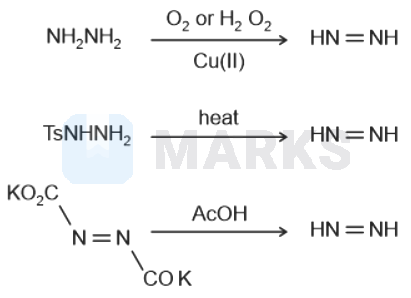
- The reagent diimide is prepared by oxidation of hydrazine, by decomposition of tosylhydrazide, or from azodicarboxylic acid.
- It is a suitable reducing agent for symmetrical double bonds such as \(\mathrm{C}=\mathrm{C}\), and \(\mathrm{N}=\mathrm{N}\), but unsymmetrical, more polar bonds such as \(\mathrm{C}=\mathrm{N}, \mathrm{C}=\mathrm{N}, \mathrm{N}=\mathrm{O}\), and \(\mathrm{S}=\mathrm{O}\) are not reduced. It is particularly suitable for reduction in the presence of other reactive functional groups, or in cases that are unsuccessful with catalytic hydrogenation.
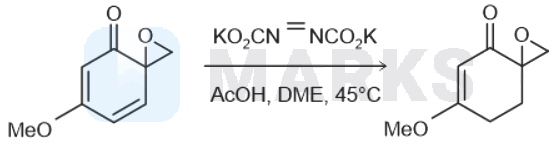
- On reaction with diimide, only the less-conjugated alkene in the substrate is reduced by diimide without affecting the other double bonds or the epoxide ring, whereas catalytic hydrogenation promotes epoxide opening to give the phenol.
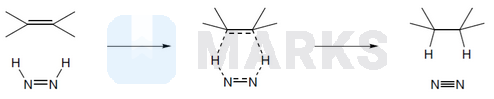
- The reactions are highly stereoselective, taking place by cis-addition of hydrogen in all cases. Transfer of the hydrogen atoms is thought to take place simultaneously through a cyclic six-membered transition state. This mechanism explains the stereospecificity of the reaction, and couples the driving force of nitrogen formation with the addition reaction. Concerted cis-transfer of hydrogen is a symmetry allowed process.
Explanation:-
- The reaction pathway is shown below:
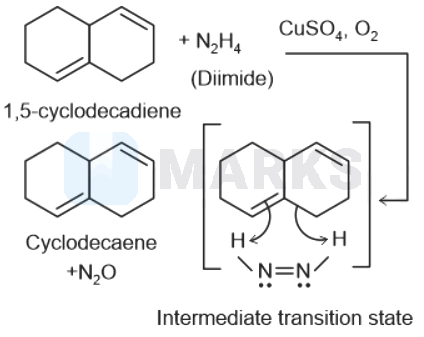
- In the first step of the reaction, 1 eq. of hydrazine \(\left(\mathrm{NH}_2 \mathrm{NH}_2\right)\) undergoes in situ by oxidation in the presence of oxygen and \(\mathrm{Cu}(\mathrm{II})\) which act as an oxidizing agent to give 1 eq. of diimide ( \(\mathrm{NH}=\mathrm{NH}\)).
- The diimide reduces only the less-conjugated alkene in a substrate.
- But in the above substrate both the \(\mathbf{C = C}\) double bond is disubstituted, one of the \(\mathbf{C}=\mathrm{C}\) double bond is in \(\mathbf{Z}\) conformation while the other one is in \(\mathbf{E}\) conformation.
- 1 eq. of diimide \((\mathrm{NH}=\mathrm{NH})\) reagent will the reduce the \(\mathbf{E}\)-alkene stereospecifically to give the final product.
Conclusion:-
- Hence, the major product \(M\) formed in the following reaction is
Reductions with diimide:
- Isolated carbon-carbon double bonds can be reduced with hydrazine \(\left(\mathrm{NH}_2 \mathrm{NH}_2\right)\) in the presence of oxygen or an oxidizing agent.
- The actual reducing agent in these reactions is the highly active species diimide, \(\mathrm{HN}=\mathrm{NH}\), formed in situ by oxidation of hydrazine.
- This compound is a highly selective reducing agent which in many cases offers a useful alternative to catalytic hydrogenation for the reduction of carbon-carbon multiple bonds.
- The reagent diimide is prepared by oxidation of hydrazine, by decomposition of tosylhydrazide, or from azodicarboxylic acid.
- It is a suitable reducing agent for symmetrical double bonds such as \(\mathrm{C}=\mathrm{C}\), and \(\mathrm{N}=\mathrm{N}\), but unsymmetrical, more polar bonds such as \(\mathrm{C}=\mathrm{N}, \mathrm{C}=\mathrm{N}, \mathrm{N}=\mathrm{O}\), and \(\mathrm{S}=\mathrm{O}\) are not reduced. It is particularly suitable for reduction in the presence of other reactive functional groups, or in cases that are unsuccessful with catalytic hydrogenation.
- On reaction with diimide, only the less-conjugated alkene in the substrate is reduced by diimide without affecting the other double bonds or the epoxide ring, whereas catalytic hydrogenation promotes epoxide opening to give the phenol.
- The reactions are highly stereoselective, taking place by cis-addition of hydrogen in all cases. Transfer of the hydrogen atoms is thought to take place simultaneously through a cyclic six-membered transition state. This mechanism explains the stereospecificity of the reaction, and couples the driving force of nitrogen formation with the addition reaction. Concerted cis-transfer of hydrogen is a symmetry allowed process.
Explanation:-
- The reaction pathway is shown below:
- In the first step of the reaction, 1 eq. of hydrazine \(\left(\mathrm{NH}_2 \mathrm{NH}_2\right)\) undergoes in situ by oxidation in the presence of oxygen and \(\mathrm{Cu}(\mathrm{II})\) which act as an oxidizing agent to give 1 eq. of diimide ( \(\mathrm{NH}=\mathrm{NH}\)).
- The diimide reduces only the less-conjugated alkene in a substrate.
- But in the above substrate both the \(\mathbf{C = C}\) double bond is disubstituted, one of the \(\mathbf{C}=\mathrm{C}\) double bond is in \(\mathbf{Z}\) conformation while the other one is in \(\mathbf{E}\) conformation.
- 1 eq. of diimide \((\mathrm{NH}=\mathrm{NH})\) reagent will the reduce the \(\mathbf{E}\)-alkene stereospecifically to give the final product.
Conclusion:-
- Hence, the major product \(M\) formed in the following reaction is
Hence, the correct answer is option: 'B'.