Q147 / 200 · Manipal (MET) 2014 · Physics
The kinetic energy $k$ of a particle moving along a circle of radius $R$ depends on the distance covered. It is given as $\mathrm{KE}=a s^2$, where $a$ is a constant. The force acting on the particle is
- A$2 a \frac{s^2}{R}$
- Correct answerB$2 a s\left(1+\frac{s^2}{R^2}\right)^{1 / 2}$
- C$2 a \mathrm{~s}$
- D$2 a \frac{R^2}{s}$
Solution
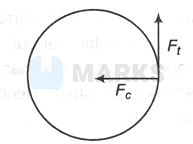
In non-uniform circular motion two forces will work on a particle $F_c$ and $F_t$.
So, the net force $F_{\text {Net }}=\sqrt{F_c^2+F_t^2}$...(i)
Centripetal force $F_c=\frac{m v^2}{R}=\frac{2 a s^2}{R}$...(ii)
[given $\frac{1}{2} m v^2=a s^2$ given]
Again from $\frac{1}{2} m v^2=a s^2$
$\Rightarrow \quad v^2=\frac{2 a s^2}{m}$
$\Rightarrow \quad v=s \sqrt{\frac{2 a}{m}}$ Tangential acceleration $a_t=\frac{d v}{d t}=\frac{d v}{d s} \cdot \frac{d s}{d t}$ $\Rightarrow \quad a_t=\frac{d}{d s}\left[s \sqrt{\frac{2 a}{m}}\right] \cdot v$ $a_t=v \sqrt{\frac{2 a}{m}}=s \sqrt{\frac{2 a}{m}} \sqrt{\frac{2 a}{m}}=\frac{2 a s}{m}$ and $\quad F_t=m a_t=2 a s$...(iii) Now, on substituting value of $F_c$ and $F_t$ in Eq. (i), we get $\therefore F_{\text {Net }}=\sqrt{\left(\frac{2 a s^2}{R}\right)^2+(2 a s)^2}=2 a s\left[1+\frac{s^2}{R^2}\right]^{1 / 2}$
$\Rightarrow \quad v=s \sqrt{\frac{2 a}{m}}$ Tangential acceleration $a_t=\frac{d v}{d t}=\frac{d v}{d s} \cdot \frac{d s}{d t}$ $\Rightarrow \quad a_t=\frac{d}{d s}\left[s \sqrt{\frac{2 a}{m}}\right] \cdot v$ $a_t=v \sqrt{\frac{2 a}{m}}=s \sqrt{\frac{2 a}{m}} \sqrt{\frac{2 a}{m}}=\frac{2 a s}{m}$ and $\quad F_t=m a_t=2 a s$...(iii) Now, on substituting value of $F_c$ and $F_t$ in Eq. (i), we get $\therefore F_{\text {Net }}=\sqrt{\left(\frac{2 a s^2}{R}\right)^2+(2 a s)^2}=2 a s\left[1+\frac{s^2}{R^2}\right]^{1 / 2}$
Hence, the correct answer is option: 'B'.