Q67 / 67 · NEST (NISER) 2021 (Session 1) · Physics
The inhalation and exhalation processes of breathing are modelled using a relationship between the gauge pressure $(P)$ and volume $(V)$ of lungs as $V=A[1-\exp (-k P)]$ where $A$ and $k$ are the positive constants (see figure for a schematic sketch). For a healthy human adult, during inhalation $A=3.57 \times 10^{-3} \mathrm{~m}^3$ and $k=0.964 \times 10^{-3}$ $\mathrm{Pa}^{-1}$. The corresponding values during exhalation are given as $A=3.35 \times 10^{-3} \mathrm{~m}^3$ and $k=1.644 \times 10^{-3} \mathrm{~Pa}^{-1}$. The maximum volume of lungs (at the end of inhalation) is approximately equal to $3.31 \times 10^{-3} \mathrm{~m}^3$ and the pressure at the maximum volume is $2.717 \times 10^3 \mathrm{~Pa}$. Assuming air to be an ideal diatomic gas, choose the correct statement(s).
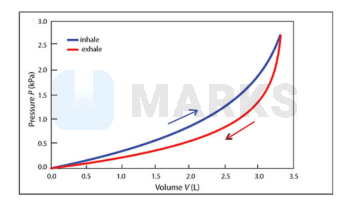
- Correct answerAThe net work done by human body during one complete inhale-exhale cycle is approximately 0.82 J
- B$d P / d V$ is zero at the beginning of the inhalation process.
- Correct answerCThe model assumes that volume of lung collapses to zero at the absolute pressure equal to atmospheric pressure.
- Correct answerDThe heat input during inhale process is around 25 J .
Hence, the correct answer is options: 'A', 'C', 'D'.