Q116 / 200 · Manipal (MET) 2014 · Mathematics
The image of the point with position vector $\hat{\mathbf{i}}+3 \hat{\mathbf{k}}$ in the plane $\mathbf{r} \cdot(\hat{\mathbf{i}}+\hat{\mathbf{j}}+\hat{\mathbf{k}})=1$ is
- A$\hat{\mathbf{i}}+2 \hat{\mathbf{j}}+\hat{\mathbf{k}}$
- B$\hat{\mathbf{i}}-2 \hat{\mathbf{j}}+\hat{\mathbf{k}}$
- Correct answerC$-\hat{\mathbf{i}}-2 \hat{\mathbf{j}}+\hat{\mathbf{k}}$
- D$\hat{\mathbf{i}}+2 \hat{\mathbf{j}}-\hat{\mathbf{k}}$
Solution
Let $Q$ be the image of the point $P(\hat{\mathbf{i}}+3 \hat{\mathbf{k}})$ in the plane $r \cdot(\hat{\mathbf{i}}+\hat{\mathbf{j}}+\hat{\mathbf{k}})=1$. Then $P Q$ is normal to the plane. Since $P Q$ passes through $P$ and is normal to the given plane, therefore equation of $P Q$ is
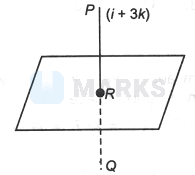
$\mathbf{r}=(\hat{\mathbf{i}}+3 \hat{\mathbf{k}})+\lambda(\hat{\mathbf{i}}+\hat{\mathbf{j}}+\hat{\mathbf{k}})$
Since, $Q$ lies on the line $P Q$, so, let the position vector of $Q$ be $(\hat{\mathbf{i}}+3 \hat{\mathbf{k}})+\lambda(\hat{\mathbf{i}}+\hat{\mathbf{j}}+\hat{\mathbf{k}})$ $\Rightarrow(1+\lambda) \hat{\mathbf{i}}+\lambda \hat{\mathbf{j}}+(3+\lambda) \hat{\mathbf{k}}$
Since $R$ is the mid point of $P Q$, therefore position vector of $R$ is $\begin{aligned} & \frac{(1+\lambda) \mathbf{i}+\lambda \mathbf{j}+(3+\lambda) \hat{\mathbf{k}}+\hat{\mathbf{i}}+3 \hat{\mathbf{k}}}{2} \\ & \text { or }\left(\frac{\lambda+2}{2}\right) \mathbf{i}+\left(\frac{\lambda}{2}\right) \hat{\mathbf{j}}+\left(3+\frac{\lambda}{2}\right) \hat{\mathbf{k}} \\ & \text { or }\left(\frac{\lambda}{2}+1\right) \hat{\mathbf{i}}+\left(\frac{\lambda}{2}\right) \hat{\mathbf{j}}+\left(3+\frac{\lambda}{2}\right) \hat{\mathbf{k}} \end{aligned}$
Since, $R$ less on the plane r$\cdot(\hat{\mathbf{i}}+\hat{\mathbf{j}}+\hat{\mathbf{k}})=1$ Therefore, $\begin{array}{ll} {\left[\left(\frac{\lambda}{2}+1\right) \hat{\mathbf{i}}+\left(\frac{\lambda}{2}\right) \hat{\mathrm{j}}+\left(3+\frac{\lambda}{2}\right) \hat{\mathbf{k}}\right] \cdot(\hat{\mathbf{i}}+\hat{\mathrm{j}}+\hat{\mathrm{k}})} & =1 \\ \Rightarrow \left(\frac{\lambda}{2}+1+\frac{\lambda}{2}+3+\frac{\lambda}{2}\right) \\ \Rightarrow \lambda=-2 \end{array}$
So, the position vector of $Q$ is $(\hat{\mathbf{i}}+3 \hat{\mathbf{k}})-2(\hat{\mathbf{i}}+\hat{\mathbf{j}}+\hat{\mathbf{k}})=-\hat{\mathbf{i}}-2 \hat{\mathbf{j}}+\hat{\mathbf{k}}$
Hence, the correct answer is option: 'C'.