Q57 / 75 · JEE Main 2026 (04 April Shift 1) · Physics
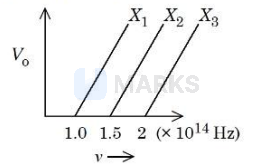
The graph shows variation of stopping potential $V_o$ with the frequency $\nu$ of the incident radiation for three photosensitive metals $X_1$, $X_2$ and $X_3$. Which metal will give out electrons with greater kinetic energy, for the same wavelength of incident radiation?
- Correct answerA$X_1$
- B$X_2$
- C$X_3$
- DAll the metals will give out photo electrons with same kinetic energies.
Solution
From Einstein's photoelectric equation, the maximum kinetic energy of emitted photoelectrons is given by:
$K_{\text{max}} = \dfrac{hc}{\lambda} - \Phi$
where $\lambda$ is the wavelength of incident radiation and $\Phi$ is the work function of the metal.
The work function is related to the threshold frequency $\nu_0$ by $\Phi = h\nu_0$. From the given graph, the x-intercept represents the threshold frequency. We can observe that:
$\nu_0(X_1) < \nu_0(X_2) < \nu_0(X_3)$
Therefore, the work functions of the metals follow the order:
$\Phi(X_1) < \Phi(X_2) < \Phi(X_3)$
For the same wavelength $\lambda$ of incident radiation, the term $\dfrac{hc}{\lambda}$ is constant. Thus, the kinetic energy $K_{\text{max}}$ will be greatest for the metal with the smallest work function.
Since metal $X_1$ has the minimum work function, it will emit electrons with the greatest kinetic energy.
Answer: $X_1$
Hence, the correct answer is option: 'A'.