Q74 / 150 · MHT CET 2007 · Mathematics
The function $f(x)=e^{-|x|}$ is
- Correct answerAcontinuous everywhere but not differentiable at $x=0$
- Bcontinuous and differentiable everywhere
- Cnot continuous at $x=0$
- DNone of the above
Solution
Given, $f(x)=\left\{\begin{array}{r}e^{-x}, x \geq 0 \\ e^{x}, x < 0\end{array}\right.$
$$
\begin{array}{l}
\text { LHL }=\lim _{x \rightarrow 0^{-}} f(x)=\lim _{x \rightarrow 0} e^{x}=1 \\
\text { RHL }=\lim _{x \rightarrow 0^{+}} f(x)=\lim _{x \rightarrow 0} e^{-x}=1 \\
\text { Also, } \quad f(0)=e^{0}=1
\end{array}
$$
$\because$
$$
\mathrm{LHL}=\mathrm{RHL}=f(0)
$$
$\therefore$ It is continuous for every value of $x$.
Now, LHD at $x=0$
$$
\left(\frac{d}{d x} e^{x}\right)_{x=0}=\left[e^{x}\right]_{x=0}=e^{0}=1
$$
RHD at $x=0$
$$
\left(\frac{d}{d x} e^{-x}\right)_{x=0}=\left[-e^{-x}\right]_{x=0}=-1
$$
So, $f(x)$ is not differentiable at $x=0$. Hence, $f(x)=e^{-\dashv x \mid}$ is continuous everywhere but not differentiable at $x=0$.
Alternative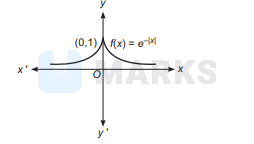
Hence, it is clear from the figure that $f(x)$ is continuous everywhere and not differentiable at $x=0 .$ $$
Hence, it is clear from the figure that $f(x)$ is continuous everywhere and not differentiable at $x=0 .$ $$
Hence, the correct answer is option: 'A'.