Q138 / 180 · KCET 2021 · Physics
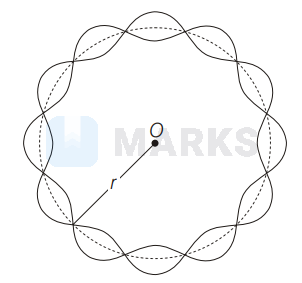
The figure shows standing de-Broglie waves due to the revolution of electron in a certain orbit of hydrogen atom. Then, the expression for the orbit radius is (All notations have their usual meanings )
- A$\frac{h^{2} \varepsilon_{0}}{\pi m e^{2}}$
- B$\frac{4 h^{2} \varepsilon_{0}}{\pi m e^{2}}$
- C$\frac{9 h^{2} \varepsilon_{0}}{\pi m e^{2}}$
- Correct answerD$\frac{36 h^{2} \varepsilon_{0}}{\pi m e^{2}}$
Solution
According to de-Broglie, the circumference of a stationary orbit must be an integral number of wavelengths.
$\begin{aligned}
&\qquad n \lambda=2 \pi r_{n} \\
&\text { Also, angular momentum, } m v_{n} r_{n}=\frac{n h}{2 \pi} \\
&\Rightarrow \quad m \frac{e^{2}}{2 n h \varepsilon_{0}} r_{n}=\frac{n h}{2 \pi} \quad\left[\because v_{n}=\frac{e^{2}}{2 n h \varepsilon_{0}}\right] \\
&\Rightarrow \quad r_{n}=\frac{n^{2} h^{2} \varepsilon_{0}}{m e^{2} \pi}=\frac{n^{2} h^{2} \varepsilon_{0}}{\pi m e^{2}}
\end{aligned}$
Here, number of standing waves, $n=6$ $\therefore$
$r_{n}=\frac{(6)^{2} h^{2} \varepsilon_{0}}{\pi m e^{2}}=\frac{36 h^{2} \varepsilon_{0}}{\pi m e^{2}}$
Hence, the correct answer is option: 'D'.