Q88 / 180 · COMEDK 2023 (Morning Shift) · Mathematics
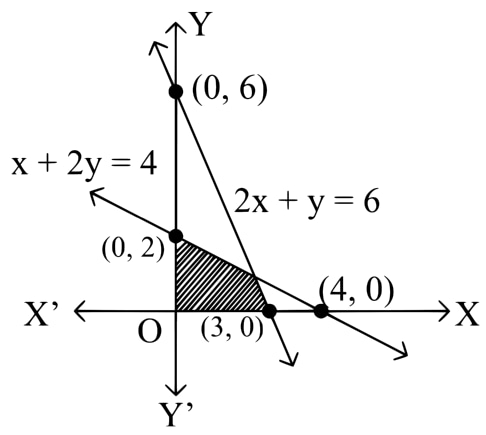
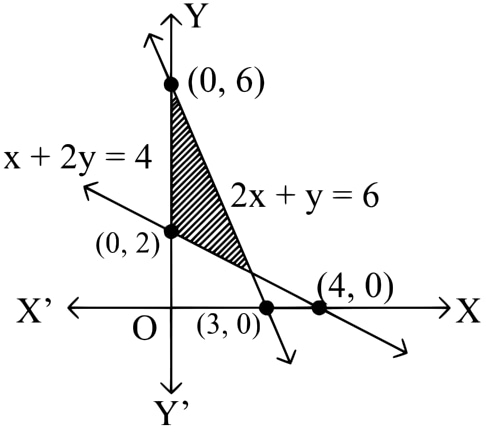
The feasible region for the inequations $x+2 y \geq 4,2 x+y \leq 6, x, y \geq 0$ is
- A
- Correct answerB
- C
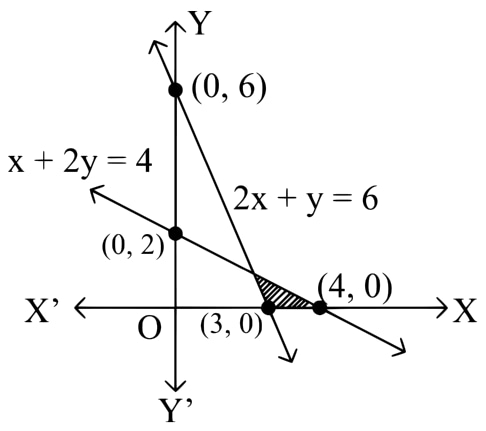
- D
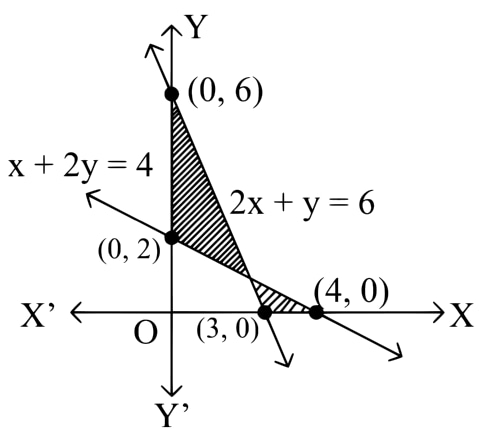
Solution
The given system of linear inequalities is $x + 2y \geq 4$, $2x + y \leq 6$, $x \geq 0$, and $y \geq 0$.
First, consider the boundary lines:
1. $x + 2y = 4$: This line passes through $(0, 2)$ and $(4, 0)$.
2. $2x + y = 6$: This line passes through $(0, 6)$ and $(3, 0)$.
Next, determine the intersection point of the two lines:
From $x + 2y = 4$, we have $x = 4 - 2y$.
Substituting into $2x + y = 6$:
$2(4 - 2y) + y = 6 \Rightarrow 8 - 4y + y = 6 \Rightarrow -3y = -2 \Rightarrow y = \dfrac{2}{3}$.
Then $x = 4 - 2(\dfrac{2}{3}) = 4 - \dfrac{4}{3} = \dfrac{8}{3}$.
The intersection point is $(\dfrac{8}{3}, \dfrac{2}{3})$.
Now, analyze the regions:
The inequality $x + 2y \geq 4$ represents the region on or above the line $x + 2y = 4$.
The inequality $2x + y \leq 6$ represents the region on or below the line $2x + y = 6$.
The conditions $x \geq 0$ and $y \geq 0$ restrict the region to the first quadrant.
The feasible region is bounded by the y-axis, the line $x + 2y = 4$ (from $(0, 2)$ to $(\dfrac{8}{3}, \dfrac{2}{3})$), and the line $2x + y = 6$ (from $(\dfrac{8}{3}, \dfrac{2}{3})$ to $(0, 6)$). This corresponds to the triangle with vertices $(0, 2)$, $(0, 6)$, and $(\dfrac{8}{3}, \dfrac{2}{3})$.
Comparing this with the given options, the second image represents this region.
Answer:
Hence, the correct answer is option: 'B'.