Q54 / 200 · NEET 2006 · Chemistry
The electronegativity difference between $\mathrm{N}$ and $\mathrm{F}$ is greater that that between $\mathrm{N}$ and $\mathrm{H}$ yet the dipole moment of $\mathrm{NH}_3$ (1.5 D) is larger than that of $\mathrm{NF}_3(0.2 \mathrm{D})$. This is because:
- AIn \(\mathrm{NH}_3\) as well as in \(\mathrm{NF}_3\) the atomic dipole and bond dipole are in the same direction
- BIn \(\mathrm{NH}_3\) the atomic dipole and bond dipole are in the same direction whereas in \(\mathrm{NF}_3\) these are in opposite directions
- Correct answerCIn \(\mathrm{NH}_3\) as well as \(\mathrm{NF}_3\) the atomic dipole and bond dipole are in opposite directions
- DIn \(\mathrm{NH}_3\) the atomic dipole and bond dipole are in the opposite directions whereas in \(\mathrm{NF}_3\) these are in the same direction
Solution
The electronegativity of $\mathrm{N}$ is greater than that of $\mathrm{H}_{\text {in }} \mathrm{NH}_3$, but in $\mathrm{NF}_3$, the electronegativity of $\mathrm{F}$ is greater than that of $\mathrm{N}$. In $\mathrm{NH}_3$, the atomic dipole and bond dipole are in the same direction, whereas in $\mathrm{NF}_3$, these are in opposite directions.
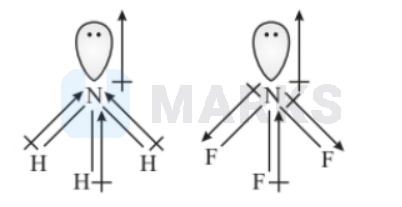
Related Theory The ammonia molecule has a permanent electric dipole moment equal to 1. $47 \mathrm{D}$. A Caution The larger the difference in electronegativity, the larger the dipole moment.
Related Theory The ammonia molecule has a permanent electric dipole moment equal to 1. $47 \mathrm{D}$. A Caution The larger the difference in electronegativity, the larger the dipole moment.
Hence, the correct answer is option: 'C'.