Q104 / 200 · Manipal (MET) 2010 · Mathematics
The distance of the point $(2,3)$ from the line $2 x-3 y+9=0$ measured along a line $x-y+1=0$ is
- Correct answerA$4 \sqrt{2}$
- B$2 \sqrt{2}$
- C$\sqrt{2}$
- D$\frac{1}{\sqrt{2}}$
Solution
The slope of the line $x-y+1=0$ is 1 . So, it makes an angle of $45^{\circ}$ with $x$-axis.
The equation of a line passing through $(2,3)$ and making an angle of $45^{\circ}$
$\frac{x-2}{\cos 45^{\circ}}=\frac{y-3}{\sin 45^{\circ}}=r$
Coordinates of any point on this line are $\left(2+r \cos 45^{\circ}, 3+r \sin 45^{\circ}\right)$
or, $\left(2+\frac{r}{\sqrt{2}}, 3+\frac{r}{\sqrt{2}}\right)$
If this point lies on the line $2 x-3 y+9=0$, then $4+\sqrt{2} r-9-\frac{3 r}{\sqrt{2}}+9=0$
$\Rightarrow r=4 \sqrt{2}$
Alternate Method
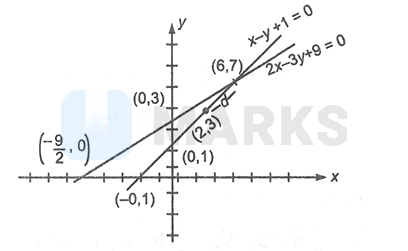
Since the point $(2,3)$ lies on the line $x-y+1=0$. Therefore the distance from $(2,3)$ to the line $2 x-3 y+9=0$ along the line $x-y+1=0$ is equal to the distance between the points $(2,3)$ and intersection point of $2 x-3 y+9=0$ and $x-y+1=0$ ie, $(6,7)$. Hence required distance, $\begin{aligned} & d=\sqrt{(6-2)^2+(7-3)^2}=\sqrt{32} \\ & d=4 \sqrt{2} \end{aligned}$
Since the point $(2,3)$ lies on the line $x-y+1=0$. Therefore the distance from $(2,3)$ to the line $2 x-3 y+9=0$ along the line $x-y+1=0$ is equal to the distance between the points $(2,3)$ and intersection point of $2 x-3 y+9=0$ and $x-y+1=0$ ie, $(6,7)$. Hence required distance, $\begin{aligned} & d=\sqrt{(6-2)^2+(7-3)^2}=\sqrt{32} \\ & d=4 \sqrt{2} \end{aligned}$
Hence, the correct answer is option: 'A'.