Q174 / 200 · MHT CET - Medical 2026 (22 April Shift 1) · Physics
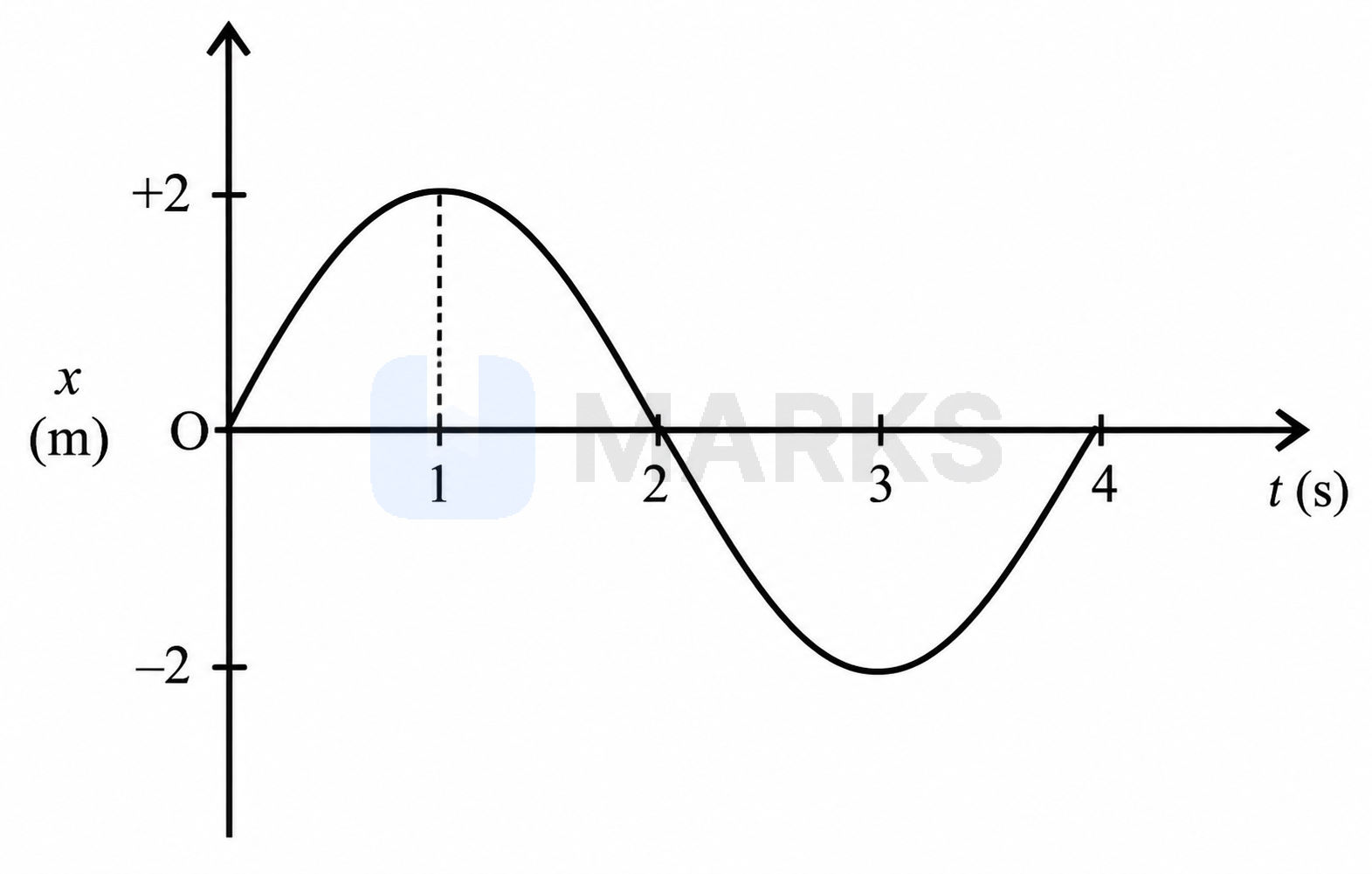
The displacement time (x-t) graph of a particle performing simple harmonic motion is shown in the figure. The acceleration fo the particle at $t = 1$ s is
- A$\dfrac{-\pi^2}{4}$ m/s$^2$
- Correct answerB$\dfrac{-\pi^2}{2}$ m/s$^2$
- C$\dfrac{\pi^2}{4}$ m/s$^2$
- D$\dfrac{\pi^2}{2}$ m/s$^2$
Solution
From the given displacement-time graph, the amplitude of the simple harmonic motion is $A = 2$ m.
The time period of the motion is $T = 4$ s.
The angular frequency is given by $\omega = \dfrac{2\pi}{T} = \dfrac{2\pi}{4} = \dfrac{\pi}{2}$ rad/s.
The acceleration of a particle in SHM is given by $a = -\omega^2 x$.
At $t = 1$ s, the displacement of the particle is $x = +2$ m (as seen from the graph).
Substituting the values, we get:
$a = -\left(\dfrac{\pi}{2}\right)^2 \times 2$
$a = -\dfrac{\pi^2}{4} \times 2 = -\dfrac{\pi^2}{2}$ m/s$^2$.
Answer: $\dfrac{-\pi^2}{2}$ m/s$^2$
Hence, the correct answer is option: 'B'.