Q5 / 160 · AP EAMCET 2022 (06 Jul Shift 2) · Chemistry
The correct order of dipole moment of the molecules $\mathrm{NH}_3$ (I), $\mathrm{BF}_3$ (II), $\mathrm{H}_2 \mathrm{O}$ (III), $\mathrm{NF}_3$ (IV) is
- Correct answerAIII $>$ I $>$ IV $>$ II
- BIV $>$ I $>$ III $>$ II
- CI $>$ IV $>$ II $>$ III
- DIII $>$ II $>$ I $>$ IV
Solution
Dipole moment is a vector quantity. It is defined as the product of the magnitude of the charge and the distance between the centres of the positive and negative charges.
Dipole moment of $\mathrm{NF}_3$ and $\mathrm{NH}_3$ The dipole moment of $\mathrm{NH}_3$ is larger than $\mathrm{NF}_3$ because in $\mathrm{NH}_3$, the dipole moment vector of the bond and the lone pairs are in the same direction, while in $\mathrm{NF}_3$, molecule, the dipole moment vector of the lone pair and the bond pairs are opposite in direction.
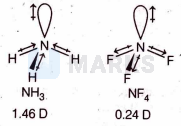
Dipole moment of $\mathrm{H}_2 \mathrm{O}$ and $\mathrm{NH}_3$ They both have dipole moment because they do not have regular geometries. Dipole moment of $\mathrm{H}_2 \mathrm{O}$ is more than $\mathrm{NH}_3$ because $\mathrm{O}$ is more electronegative than $\mathrm{N}$.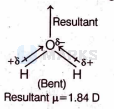
Dipole moment of $\mathbf{B F}_3$ It is zero because it has symmetrical (triangular planar) structure.
Therefore, the correct order of dipole moments of molecules is $$ \mathrm{H}_2 \mathrm{O} \text { (III) }>\mathrm{NH}_3 \text { (I) }>\mathrm{NF}_3 \text { (IV) }>\mathrm{BF}_3 \text { (II) } $$
Dipole moment of $\mathrm{H}_2 \mathrm{O}$ and $\mathrm{NH}_3$ They both have dipole moment because they do not have regular geometries. Dipole moment of $\mathrm{H}_2 \mathrm{O}$ is more than $\mathrm{NH}_3$ because $\mathrm{O}$ is more electronegative than $\mathrm{N}$.
Dipole moment of $\mathbf{B F}_3$ It is zero because it has symmetrical (triangular planar) structure.
Therefore, the correct order of dipole moments of molecules is $$ \mathrm{H}_2 \mathrm{O} \text { (III) }>\mathrm{NH}_3 \text { (I) }>\mathrm{NF}_3 \text { (IV) }>\mathrm{BF}_3 \text { (II) } $$
Hence, the correct answer is option: 'A'.