Q106 / 150 · MHT CET 2024 (16 May Shift 2) · Physics
The bob of a pendulum of length ' $l$ ' is pulled aside from its equilibrium position through an angle ' $\theta$ ' and then released. The bob will then pass through its equilibrium position with speed ' $v$ ', where ' $v$ ' equal to ( $g=$ acceleration due to gravity)
- Correct answerA$\sqrt{2 g l(1-\cos \theta)}$
- B$\sqrt{2 g l(1+\sin \theta)}$
- C$\sqrt{2 g l(1-\sin \theta)}$
- D$\sqrt{2 \mathrm{~g} l(1+\cos \theta)}$
Solution
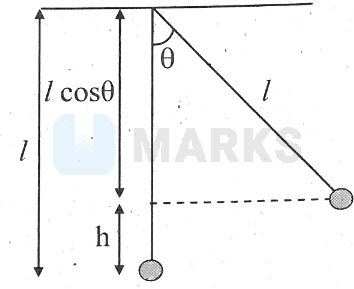
When bob of a pendulum rises up a height ' $h$ ' potential energy at extreme position becomes kinetic energy of mean position. $\begin{array}{ll} & \mathrm{mgh}=\frac{1}{2} \mathrm{mv}_{\max }^2 \\ \therefore \quad & \mathrm{v}_{\max }=\sqrt{2 \mathrm{gh}} \\ \quad & l=\mathrm{h}+l \cos \theta \\ \therefore \quad & \mathrm{~h}=l(1-\cos \theta) \\ \therefore \quad & \mathrm{v}_{\max }=\sqrt{2 \mathrm{gl}(1-\cos \theta)} \end{array}$
Hence, the correct answer is option: 'A'.