Q108 / 160 · JIPMER 2014 · Physics
The angular amplitude of a simple pendulum is $\theta_0$. The maximum tension in its string will be
- A$m g\left(1-\theta_0\right)$
- B$m g\left(1+\theta_0\right)$
- C$m g\left(1-\theta_0^2\right)$
- Correct answerD$m g\left(1+\theta_0^2\right)$
Solution
The simple pendulum at angular amplitude $\theta_0$ is shown in the figure.
$T_{\max }=m g+\frac{m v^2}{I} \quad \ldots(i)$
When, bob of pendulum comes from $A$ to $B$, it covers a vertical distance $h$.
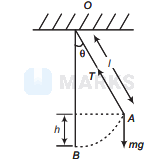 $\therefore \quad \cos \theta_0=\frac{l-h}{l}$
$\Rightarrow \quad h=I(I-\cos \theta)\ldots(ii)$
Also during $A$ to $B$, potential energy of bob converts into kinetic energy
$\therefore \quad m g h=\frac{1}{2} m v^2 \therefore \quad v=\sqrt{2 g h} \quad \ldots(iii)$
Thus, using Eqs. (i), (ii) and (iii) we obtain
$T_{\max }=m g+\frac{2 m g}{I} I\left(1-\cos \theta_0\right)$
$=m g+2 m g\left[1-1+\frac{\theta_0{ }^2}{2}\right]$ (By using binomial theorem)
$=m g\left(1+\theta_0^2\right)$
$\therefore \quad \cos \theta_0=\frac{l-h}{l}$
$\Rightarrow \quad h=I(I-\cos \theta)\ldots(ii)$
Also during $A$ to $B$, potential energy of bob converts into kinetic energy
$\therefore \quad m g h=\frac{1}{2} m v^2 \therefore \quad v=\sqrt{2 g h} \quad \ldots(iii)$
Thus, using Eqs. (i), (ii) and (iii) we obtain
$T_{\max }=m g+\frac{2 m g}{I} I\left(1-\cos \theta_0\right)$
$=m g+2 m g\left[1-1+\frac{\theta_0{ }^2}{2}\right]$ (By using binomial theorem)
$=m g\left(1+\theta_0^2\right)$Hence, the correct answer is option: 'D'.