Q6 / 180 · KCET 2014 · Chemistry
The acid strength of active methylene group in
(a) \( \mathrm{CH}_{3} \mathrm{COCH}_{2} \mathrm{COOC}_{2} \mathrm{H}_{5} \)
(b) \( \mathrm{CH}_{3} \mathrm{COCH}_{2} \mathrm{COCH}_{3} \)
(c) \( \mathrm{C}_{2} \mathrm{H}_{5} \mathrm{OOCCH}_{2} \mathrm{COOC}_{2} \mathrm{H}_{5} \)
decreases as
(a) \( \mathrm{CH}_{3} \mathrm{COCH}_{2} \mathrm{COOC}_{2} \mathrm{H}_{5} \)
(b) \( \mathrm{CH}_{3} \mathrm{COCH}_{2} \mathrm{COCH}_{3} \)
(c) \( \mathrm{C}_{2} \mathrm{H}_{5} \mathrm{OOCCH}_{2} \mathrm{COOC}_{2} \mathrm{H}_{5} \)
decreases as
- A\( a>b>0 \)
- Bc> a> b
- C\( a>c>b \)
- Correct answerD\( b>a>c \)
Solution
An active methylene compound is a compound that has the following general structural formula.

Where, \( E_{1} \) and \( E_{2} \) are functional group that withdraws electron by resonance. After the removal of hydrogen from the
active methylene groups, the carbanion thus, formed is stabilized by the resonance. Greater the stabilization of the
carbanion, greater will be the acidic strength of the active methylene groups.
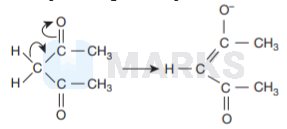
(।) \( \mathrm{CH}_{3} \mathrm{COCH}_{2} \mathrm{COOC}_{2} \mathrm{H}_{5} \)

So, ketonic groups stabilized more carbanion ion than the ester or carboxylic groups. Therefore, compound having more
number of ketonic groups is more acidic active methylene compound.
(II) \( \mathrm{CH}_{3} \mathrm{COCH}_{2} \mathrm{COCH}_{3} \)
(III) \( \mathrm{CH}_{3} \mathrm{COOCH}_{2} \mathrm{COOCH}_{3} \)
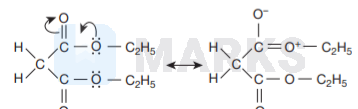
Where, \( E_{1} \) and \( E_{2} \) are functional group that withdraws electron by resonance. After the removal of hydrogen from the
active methylene groups, the carbanion thus, formed is stabilized by the resonance. Greater the stabilization of the
carbanion, greater will be the acidic strength of the active methylene groups.
(।) \( \mathrm{CH}_{3} \mathrm{COCH}_{2} \mathrm{COOC}_{2} \mathrm{H}_{5} \)
So, ketonic groups stabilized more carbanion ion than the ester or carboxylic groups. Therefore, compound having more
number of ketonic groups is more acidic active methylene compound.
(II) \( \mathrm{CH}_{3} \mathrm{COCH}_{2} \mathrm{COCH}_{3} \)
(III) \( \mathrm{CH}_{3} \mathrm{COOCH}_{2} \mathrm{COOCH}_{3} \)
Hence, the correct answer is option: 'D'.