Q51 / 69 · JEE Advanced 2008 (Paper 1) · Physics
Students I, II and III perform an experiment for measuring the acceleration due to gravity $(g)$ using a simple pendulum. They use different lengths of the pendulum and/or record time for different number of oscillations. The observations are shown in the table.
Least count for length $=0.1 \mathrm{~cm}$
Least count for time $=0.1 \mathrm{~s}$
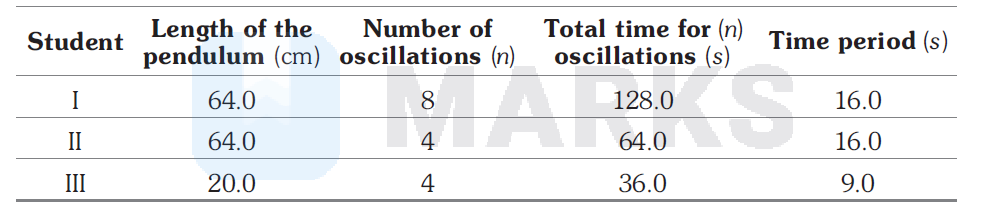
If $E_{\mathrm{I}}, E_{\mathrm{II}}$ and $E_{\mathrm{III}}$ are the percentage errors in $g$, i.e., $\left(\frac{\Delta g}{g} \times 100\right)$ for students I, II and III, respectively.
If $E_{\mathrm{I}}, E_{\mathrm{II}}$ and $E_{\mathrm{III}}$ are the percentage errors in $g$, i.e., $\left(\frac{\Delta g}{g} \times 100\right)$ for students I, II and III, respectively.
- A$E_{\mathrm{I}}=0$
- Correct answerB$E_{\mathrm{I}}$ is minimum
- C$E_{\mathrm{I}}=E_{\mathrm{II}}$
- D$E_{\mathrm{II}}$ is maximum
Solution
$$
\begin{aligned}
& T & =2 \pi \sqrt{\frac{l}{g}} \quad \text { or } \quad \frac{t}{n}=2 \pi \sqrt{\frac{l}{g}} \\
\therefore \quad & g & =\frac{\left(4 \pi^2\right)\left(n^2\right) l}{t^2}
\end{aligned}
$$
$\%$ error in $g=\frac{\Delta g}{g} \times 100=\left(\frac{\Delta l}{l}+\frac{2 \cdot \Delta t}{t}\right) \times 100$
$$
\begin{aligned}
& E_{\mathrm{I}}=\left(\frac{0.1}{64}+\frac{2 \times 0.1}{128}\right) \times 100=0.3125 \% \\
& E_{\mathrm{II}}=\left(\frac{0.1}{64}+\frac{2 \times 0.1}{64}\right) \times 100=0.46875 \% \quad E_{\mathrm{III}}=\left(\frac{0.1}{20}+\frac{2 \times 0.1}{36}\right) \times 100=1.055 \%
\end{aligned}
$$
Hence, $E_{\mathrm{I}}$ is minimum.
$\therefore$ correct option is (b).
Hence, the correct answer is option: 'B'.