Q11 / 66 · JEE Advanced 2008 (Paper 2) · Chemistry
Statement 1 The geometrical isomer of the complex $\left.\left[\mathrm{M}_{\left(\mathrm{NH}_3\right.}\right)_4 \mathrm{Cl}_2\right]$ are optically inactive.
Statement 2 Both geometrical isomers of the complex $\left[\mathrm{M}\left(\mathrm{NH}_3\right)_4 \mathrm{Cl}_2\right]$ possess axis of symmetry.
- Correct answerAStatement 1 is true, Statement 2 is true, Statement 2 is a correct explanation for Statement 1.
- BStatement 1 is true, Statement 2 is true, Statement 2 is not a correct explanation for Statement 1.
- CStatement 1 is true, Statement 2 is false.
- DStatement 1 is false, Statement 2 is true
Solution
$$
\text { The cis and trans both form of complex }\left[M\left(\mathrm{NH}_3\right)_4 \mathrm{Cl}_2\right] \text { are optically inactive }
$$
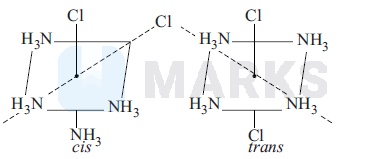
There are plane of symmetry in addition to that there is alternate axis of symmetry $\left(C_n\right)$ which also causes their optical inactivity. A molecule possesses $n$ fold alternating axis of symmetry, if when rotated through an angle of $360^{\circ} / \mathrm{n}$ about the axis and then followed by reflection in a plane perpendicular to the axis, the molecule is indistinguishable from the original molecule.
There are plane of symmetry in addition to that there is alternate axis of symmetry $\left(C_n\right)$ which also causes their optical inactivity. A molecule possesses $n$ fold alternating axis of symmetry, if when rotated through an angle of $360^{\circ} / \mathrm{n}$ about the axis and then followed by reflection in a plane perpendicular to the axis, the molecule is indistinguishable from the original molecule.
Hence, the correct answer is option: 'A'.