Q103 / 150 · MHT CET 2026 (16 April Shift 2) · Physics
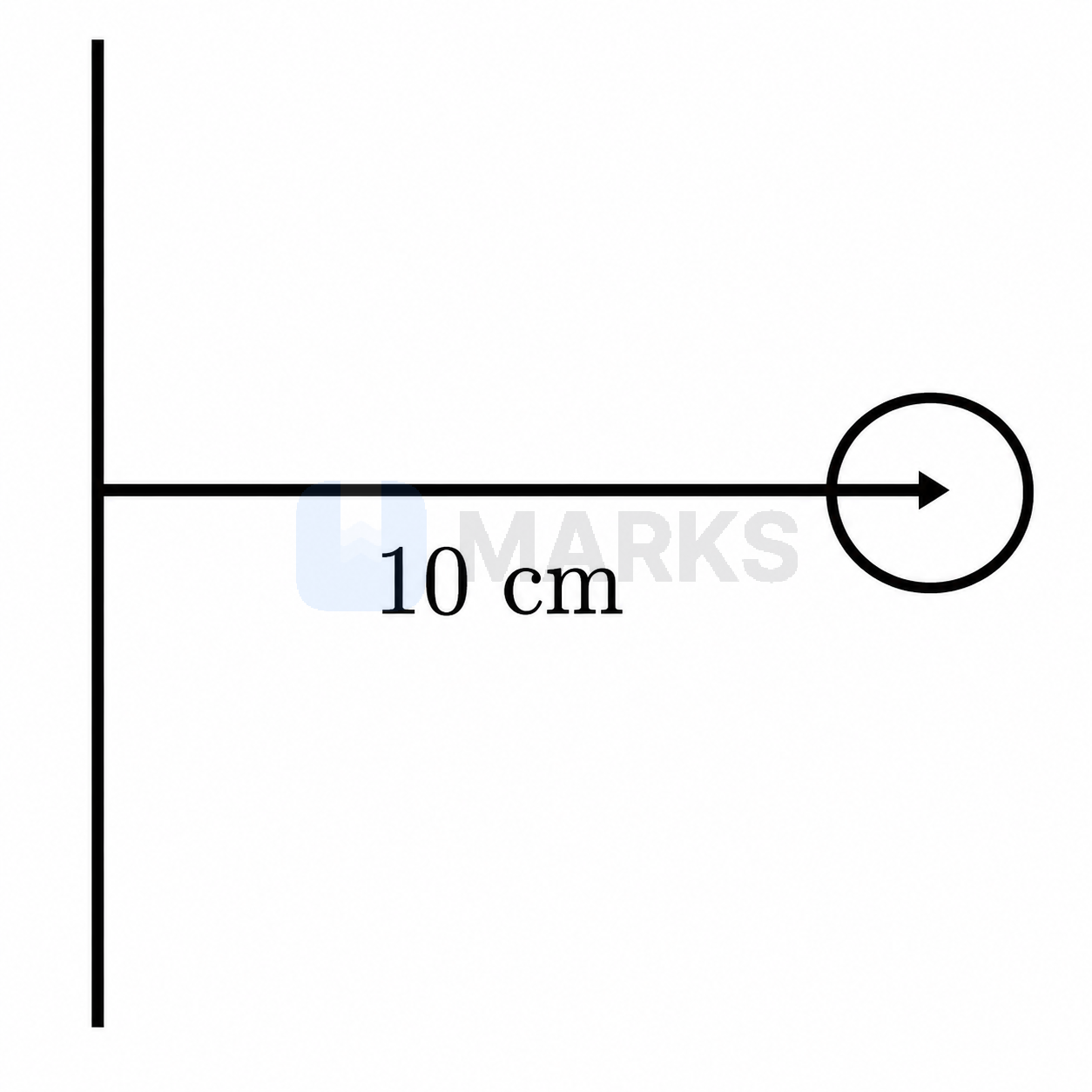
Solid sphere is rotating about an axis as shown in figure. If the radius of the sphere is 5 cm, then radius of gyration about that axis will be $\sqrt{x}$ cm. The value of x is
- A$100$
- Correct answerB$110$
- C$120$
- D$140$
Solution
The moment of inertia of a solid sphere about an axis passing through its center of mass is given by $I_{cm} = \dfrac{2}{5}MR^2$.
Using the parallel axis theorem, the moment of inertia about the given axis of rotation is:
$I = I_{cm} + Md^2$
where $d$ is the distance from the axis of rotation to the center of mass of the sphere.
Given $R = 5$ cm and $d = 10$ cm, we have:
$I = \dfrac{2}{5}M(5)^2 + M(10)^2$
$I = 10M + 100M = 110M$
The radius of gyration $k$ is defined by $I = Mk^2$.
$Mk^2 = 110M$
$k^2 = 110$
$k = \sqrt{110}$ cm
Comparing this with $\sqrt{x}$ cm, we get $x = 110$.
Hence, the correct answer is option: 'B'.