Q132 / 180 · KCET 2013 · Physics
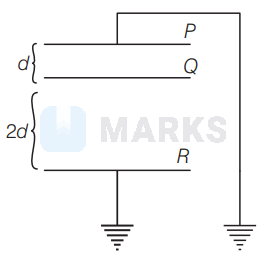
See the diagram. Area of each plate is $2.0 \mathrm{~m}^{2}$ and $d=2 \times 10^{-3} \mathrm{~m}$. A charge of $8.85 \times 10^{-8} \mathrm{C}$ is given to $Q$. Then the potential of $Q$ becomes
- A$13 \mathrm{~V}$
- B$10 \mathrm{~V}$
- Correct answerC$6.67 \mathrm{~V}$
- D$8.825 \mathrm{~V}$
Solution
In the given arrangement, plate $Q$ is common for two capacitors which are connected in parallel.
$\begin{aligned}
&\therefore \quad C_{\text {eff }}=C_{P}=C_{1}+C_{2} \\
&\Rightarrow \quad C_{P}=\frac{\varepsilon_{0} A}{d}+\frac{\varepsilon_{0} A}{2 d}=\frac{2 \varepsilon_{0} A}{2 d}
\end{aligned}$
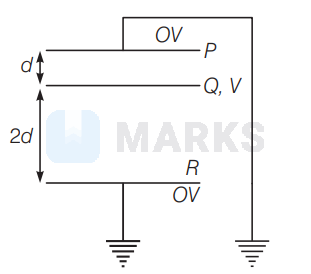
The given arrangement can be shown as
Let $V$ be the potential difference across the capacitor, which is equal to the potential of the plate $Q$
So, $\quad C=\frac{q}{V}$ i.e., $C_{\text {eff }}=\frac{q}{V}$ i.e., $\quad \frac{3 \varepsilon_{0} A}{2 d}=\frac{8.85 \times 10^{-8}}{V}$ $\begin{aligned} \Rightarrow \quad V &=\frac{8.85 \times 10^{-8} \times 2 \times 2 \times 10^{-3}}{3 \times 8.85 \times 10^{-12} \times 2} \\ &=\frac{2}{3} \times 10=\frac{20}{3}=6.67 \mathrm{~V} \end{aligned}$
So, $\quad C=\frac{q}{V}$ i.e., $C_{\text {eff }}=\frac{q}{V}$ i.e., $\quad \frac{3 \varepsilon_{0} A}{2 d}=\frac{8.85 \times 10^{-8}}{V}$ $\begin{aligned} \Rightarrow \quad V &=\frac{8.85 \times 10^{-8} \times 2 \times 2 \times 10^{-3}}{3 \times 8.85 \times 10^{-12} \times 2} \\ &=\frac{2}{3} \times 10=\frac{20}{3}=6.67 \mathrm{~V} \end{aligned}$
Hence, the correct answer is option: 'C'.