Q27 / 155 · WBJEE 2026 · Chemistry
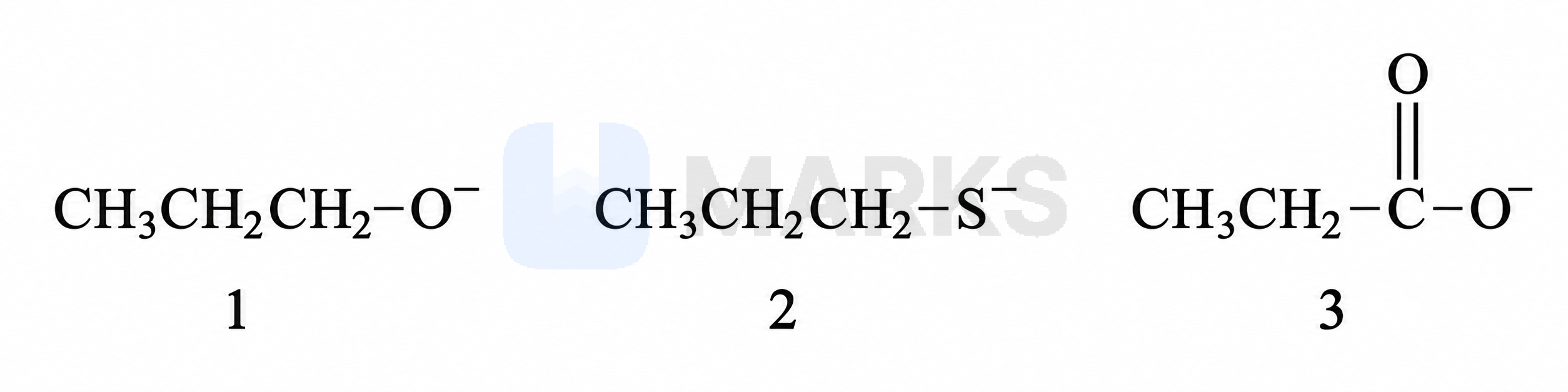
Rank the following anions in order of decreasing nucleophilicity in a polar protic solvent (most $\rightarrow$ least nucleophilic)
- A$3 > 2 > 1$
- B$2 > 3 > 1$
- C$1 > 3 > 2$
- Correct answerD$2 > 1 > 3$
Solution
Nucleophilicity in a polar protic solvent depends on the size (polarizability) of the nucleophilic atom and the availability of the lone pair (charge density).
First, compare the nucleophilic atoms: sulfur in anion 2 and oxygen in anions 1 and 3. In polar protic solvents, larger atoms are less heavily solvated by hydrogen bonding and are more polarizable. Thus, the thiolate ion (2) is a much better nucleophile than the oxygen-based anions. This gives $2 > 1$ and $2 > 3$.
Next, compare the oxygen-based anions 1 and 3. In anion 1 (propoxide), the negative charge is localized on a single oxygen atom, making it highly reactive. In anion 3 (propanoate), the negative charge is delocalized over two oxygen atoms via resonance. This resonance stabilization decreases the electron density on any single oxygen atom, making it a weaker nucleophile than the alkoxide. Thus, $1 > 3$.
Combining these observations, the order of decreasing nucleophilicity is $2 > 1 > 3$.
Answer: $2 > 1 > 3$
Hence, the correct answer is option: 'D'.