Q150 / 180 · COMEDK 2026 (9 May Shift 1) · Physics
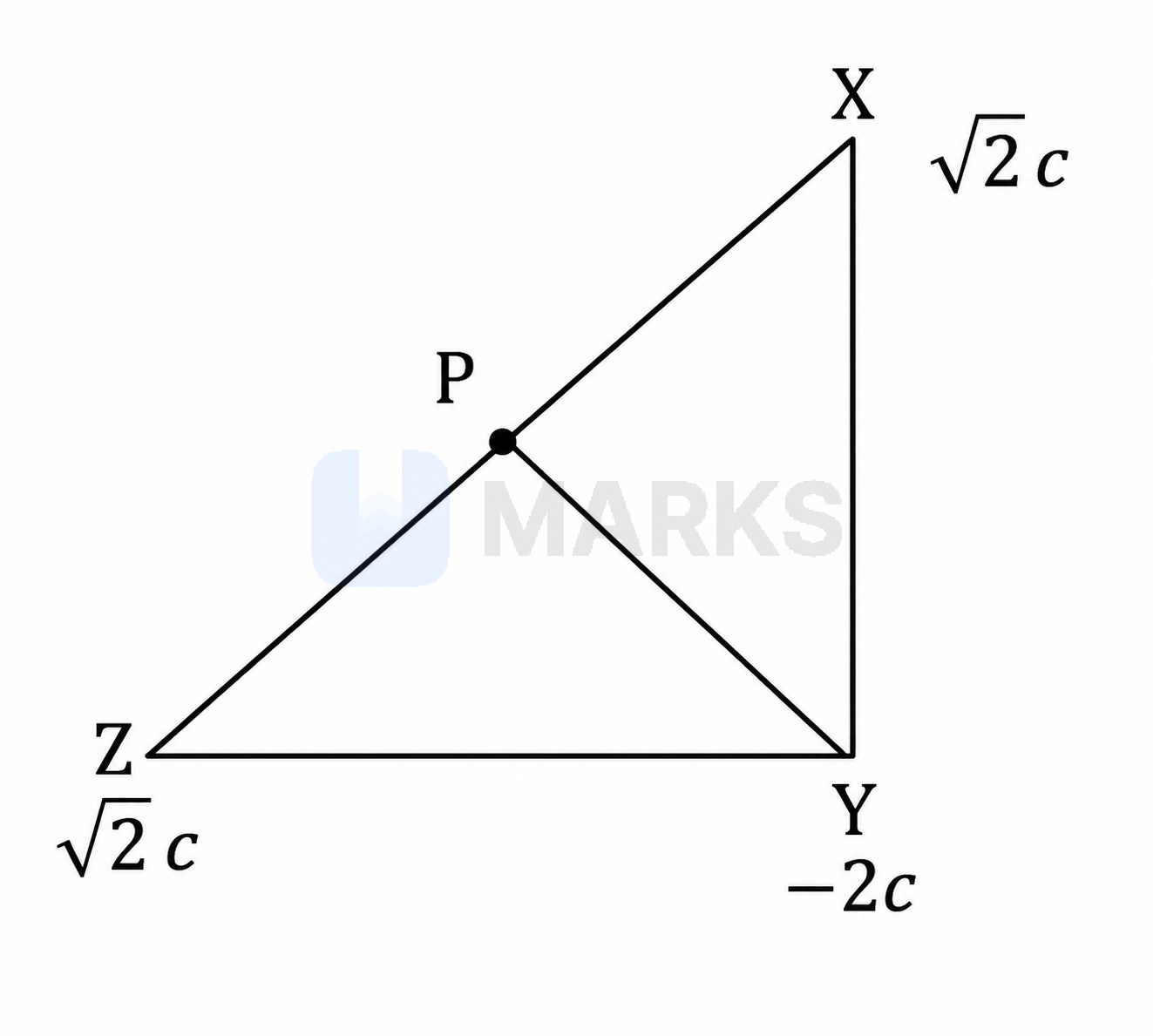
Point charge $\sqrt{2}C, \sqrt{2}C$, and $-2C$ are placed at the three vertices of a right-angled triangle in air. [as shown in the figure below] What is the electric field at a point P on the hypotenuse that is equidistant from all three charges. Given distances $XP = YP = ZP = 0.5\ m$
- A$7\cdot 2 \times 10^9\ NC^{-1}$ along PY
- Correct answerB$7\cdot 2 \times 10^{10}\ NC^{-1}$ along PY
- C$0\cdot 72 \times 10^9\ NC^{-1}$ along YP
- D$0\cdot 72 \times 10^{10}\ NC^{-1}$ along YP
Solution
Let the charges at vertices $X$, $Y$, and $Z$ be $q_X = \sqrt{2}\ C$, $q_Y = -2\ C$, and $q_Z = \sqrt{2}\ C$ respectively.
Point $P$ is on the hypotenuse $XZ$ and is equidistant from $X$ and $Z$, meaning it is the midpoint of $XZ$.
The electric field at $P$ due to the charge at $X$ is directed away from $X$ (along $PZ$) with magnitude:
$E_X = \dfrac{1}{4\pi\epsilon_0} \dfrac{q_X}{(XP)^2}$
The electric field at $P$ due to the charge at $Z$ is directed away from $Z$ (along $PX$) with magnitude:
$E_Z = \dfrac{1}{4\pi\epsilon_0} \dfrac{q_Z}{(ZP)^2}$
Since $q_X = q_Z = \sqrt{2}\ C$ and $XP = ZP = 0.5\ m$, the magnitudes are equal: $E_X = E_Z$.
As these two fields act in opposite directions along the same line, their vector sum is zero: $\vec{E}_X + \vec{E}_Z = 0$.
The net electric field at $P$ is therefore only due to the charge at $Y$.
Since $q_Y = -2\ C$ is a negative charge, the electric field $\vec{E}_Y$ is directed towards $Y$, which is along the direction $PY$.
The magnitude of the net electric field is:
$E_{net} = E_Y = \dfrac{1}{4\pi\epsilon_0} \dfrac{|q_Y|}{(YP)^2}$
Substituting the given values ($YP = 0.5\ m$ and $\dfrac{1}{4\pi\epsilon_0} = 9 \times 10^9\ N m^2 C^{-2}$):
$E_{net} = (9 \times 10^9) \times \dfrac{2}{(0.5)^2}$
$E_{net} = \dfrac{18 \times 10^9}{0.25}$
$E_{net} = 72 \times 10^9\ NC^{-1}$
$E_{net} = 7.2 \times 10^{10}\ NC^{-1}$
Thus, the electric field is $7.2 \times 10^{10}\ NC^{-1}$ along $PY$.
Answer: $7\cdot 2 \times 10^{10}\ NC^{-1}$ along PY
Hence, the correct answer is option: 'B'.