Q39 / 57 · JEE Advanced 2009 (Paper 2) · Physics
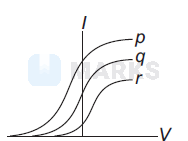
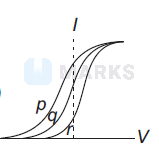
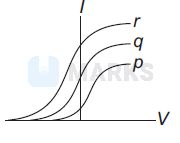
Photoelectric effect experiments are performed using three different metal plates $p, \quad q$ and $r$ having work functions $\varphi_p=2.0 \mathrm{eV}, \varphi_q=2.5 \mathrm{eV}$ and $\varphi_r=3.0 \mathrm{eV}$, respectively. A light beam containing wavelengths of $550 \mathrm{~nm}$, $450 \mathrm{~nm}$ and $350 \mathrm{~nm}$ with equal intensities illuminates each of the plates. The correct $I-V$ graph for the experiment is
- A
- B
- C
- Correct answerDNone of these
Solution
$$
\begin{gathered}
\text { 1. } K_p=E_p-\phi_p=\frac{1240}{550}-20=0.2545 \mathrm{eV} \\
K_q=E_q-\phi_q=\frac{1240}{450}-25=0.255 \mathrm{eV} \\
K_r=E_r-\phi_r=\frac{1240}{350}-3.0=0.543 \mathrm{eV}
\end{gathered}
$$
In the above equation $K$ represents maximum kinetic energy of photoelectrons and $E$, the energy of incident right. From the above values we can see that stopping potential, $\left|V_r\right|>\left|V_q\right|>\left|V_p\right|$
Further, their intensities are equal, but energy of individual photon of $r$ is maximum. Hence, number of photons incident (per unit area per unit time) of $r$ can be assumed to be least. Hence, saturation current of $r$ should be minimum.
Keeping these points in mind no option seems to be correct. The correct graph is shown below,
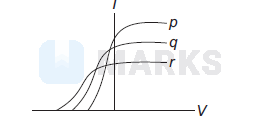
$$ \therefore \text { No choice is correct. } $$
$$ \therefore \text { No choice is correct. } $$
Hence, the correct answer is option: 'D'.