Q74 / 84 · JEE Advanced 2010 (Paper 1) · Physics
Paragraph:
When a particle of mass $m$ moves on the $x$-axis in a potential of the form $V(x)=k x^2$, it performs simple harmonic motion.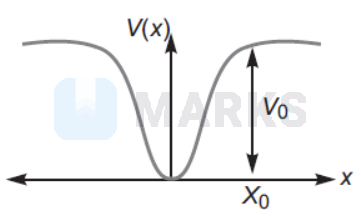
The corresponding time period is proportional to $\sqrt{\frac{m}{k}}$, as can be seen easily using dimensional analysis. However, the motion of a particle can be periodic even when its potential energy increases on both sides of $x=0$ in a way different from $k x^2$ and its total energy is such that the particle does not escape to infinity. Consider a particle of mass $\mathrm{m}$ moving on the $x$-axis. Its potential energy is $V(x)=\alpha x^4(\alpha>0)$ for $|x|$ near the origin and becomes a constant equal to $V_0$ for $|x| \geq X_0$ (see figure).Question:
The acceleration of this particle for $|x|>X_0$ is
The corresponding time period is proportional to $\sqrt{\frac{m}{k}}$, as can be seen easily using dimensional analysis. However, the motion of a particle can be periodic even when its potential energy increases on both sides of $x=0$ in a way different from $k x^2$ and its total energy is such that the particle does not escape to infinity. Consider a particle of mass $\mathrm{m}$ moving on the $x$-axis. Its potential energy is $V(x)=\alpha x^4(\alpha>0)$ for $|x|$ near the origin and becomes a constant equal to $V_0$ for $|x| \geq X_0$ (see figure).Question: The acceleration of this particle for $|x|>X_0$ is
- Aproportional to $V_0$
- Bproportional to $\frac{V_0}{m X_0}$
- Cproportional to $\sqrt{\frac{V_0}{m X_0}}$
- Correct answerDZero
Solution
For $|x|>X_0$, potential energy is constant. Hence, kinetic energy, speed or velocity will also remain constant.
$\therefore$ Acceleration will be zero.
Hence, the correct option is (d).
Hence, the correct answer is option: 'D'.