Q195 / 270 · NDA 2023 (Phase 1) · Mathematics
Paragraph:
In a triangle $P Q R, P$ is the largest angle and $\cos P=\frac{1}{3}$. Further the in-circle of the triangle touches the sides $P Q, Q R$ and $R P$ at $N, L$ and $M$ respectively such that the lengths $P N, Q L$ and $R M$ are $n, n+2, n+4$ respectively where $n$ is an integer.
Question:
What is the value of $n$ ?
Question: What is the value of $n$ ?
- A$4$
- B$6$
- Correct answerC$8$
- D$10$
Solution
$\cos P=\frac{1}{3}$
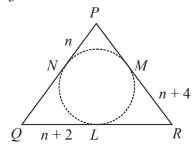
$\because \quad P M=P N=n$ $Q N=Q L=n+2$ $R M=R L=n+4$ $P Q=2 n+2$ $Q R=2 n+6$ $P R=2 n+4$ Now, $\cos P=\frac{P Q^2+P R^2-Q R^2}{2(P Q)(P R)}$ $\Rightarrow \quad \frac{1}{3}=\frac{(2 n+2)^2+(2 n+4)^2-(2 n+6)^2}{2(2 n+2)(2 n+4)}$ $\frac{1}{3}=\frac{(n+1)^2+(n+2)^2-(n+3)^2}{2(n+1)(n+2)}$ $2(n+1)(n+2)=3\left[(n+1)^2+(n+2)^2-(n+3)^2\right]$ $\Rightarrow \quad 2 n^2+6 n+4=3 n^2-12$ $\Rightarrow n^2-6 n-16=0$ $\Rightarrow(n-8)(n+2)=0 \Rightarrow \mathrm{n}=8,-2$ $\therefore \quad n=8$
$\because \quad P M=P N=n$ $Q N=Q L=n+2$ $R M=R L=n+4$ $P Q=2 n+2$ $Q R=2 n+6$ $P R=2 n+4$ Now, $\cos P=\frac{P Q^2+P R^2-Q R^2}{2(P Q)(P R)}$ $\Rightarrow \quad \frac{1}{3}=\frac{(2 n+2)^2+(2 n+4)^2-(2 n+6)^2}{2(2 n+2)(2 n+4)}$ $\frac{1}{3}=\frac{(n+1)^2+(n+2)^2-(n+3)^2}{2(n+1)(n+2)}$ $2(n+1)(n+2)=3\left[(n+1)^2+(n+2)^2-(n+3)^2\right]$ $\Rightarrow \quad 2 n^2+6 n+4=3 n^2-12$ $\Rightarrow n^2-6 n-16=0$ $\Rightarrow(n-8)(n+2)=0 \Rightarrow \mathrm{n}=8,-2$ $\therefore \quad n=8$
Hence, the correct answer is option: 'C'.