Q66 / 75 · JEE Main 2026 (02 April Shift 2) · Physics
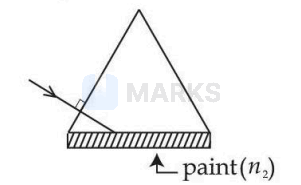
One side of an equilateral prism is painted by a transparent material of refractive index $n_2$. The refractive index of prism is $1.6$. The minimum value of $n_2$ required for total internal reflection from painted face is _______.
- A$3\sqrt{3}/1.6$
- B$\sqrt{3}$
- C$3.2/\sqrt{3}$
- Correct answerD$4\sqrt{3}/5$
Solution
Given that the prism is an equilateral triangle, all its refracting angles are $60^\circ$.
The incident ray falls normally on one of the faces of the prism. Therefore, the angle of incidence is $0^\circ$ and the ray enters the prism undeviated.
From the geometry of the figure, the ray strikes the bottom painted face. In the right-angled triangle formed by the ray and the two faces of the prism, the angle between the left face and the bottom face is $60^\circ$.
The angle the refracted ray makes with the bottom face is $90^\circ - 60^\circ = 30^\circ$.
The angle of incidence $i$ at the bottom painted face is the angle made with the normal to that face:
$i = 90^\circ - 30^\circ = 60^\circ$
For total internal reflection to occur at the painted face, the angle of incidence must be greater than or equal to the critical angle $\theta_c$ for the prism-paint interface:
$i \ge \theta_c$
$\sin i \ge \sin \theta_c$
The critical angle is given by $\sin \theta_c = \dfrac{n_2}{n_1}$, where $n_1 = 1.6$ is the refractive index of the prism and $n_2$ is the refractive index of the paint.
Substituting the values:
$\sin 60^\circ \ge \dfrac{n_2}{1.6}$
$\dfrac{\sqrt{3}}{2} \ge \dfrac{n_2}{1.6}$
$n_2 \le 1.6 \times \dfrac{\sqrt{3}}{2}$
$n_2 \le 0.8\sqrt{3} = \dfrac{4\sqrt{3}}{5}$
The limiting value of $n_2$ required for total internal reflection is $\dfrac{4\sqrt{3}}{5}$.
Answer: $4\sqrt{3}/5$
Hence, the correct answer is option: 'D'.