Q86 / 180 · JIPMER 2016 · Physics
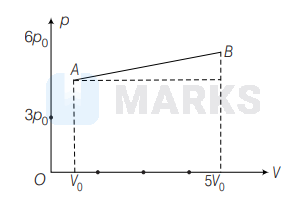
One mole of a monoatomic ideal gas undergoes the process $A \rightarrow B$ in the given $p-V$ diagram. The molar heat capacity for this process is
- A$\frac{3 R}{2}$
- Correct answerB$\frac{13 R}{6}$
- C$\frac{5 R}{2}$
- D$2 R$
Solution
$\begin{aligned} W_{A \rightarrow B} & =\text { Area under } p-V \text { diagram } \\ & =4 V_0 \times 3 p_0+\frac{1}{2} 4 V_0 \times 3 p_0=18 p_0 V_0\end{aligned}$
$\begin{aligned} \therefore \quad \Delta U & =n C_V \Delta T \\ & =1 \cdot \frac{3}{2} R\left(T_B-T_A\right) \\ & =\frac{3}{2} R\left(\frac{30 p_0 V_0}{R}-\frac{3 p_0 V_0}{R}\right) \\ & =\frac{81}{2} p_0 V_0\end{aligned}$
Thus, $\Delta Q_{A \rightarrow B}=\Delta W_{A \rightarrow B}+\Delta U_{A \rightarrow B}$
$=18 p_0 V_0+\frac{81}{2} p_0 V_0=\frac{117}{2} p_0 V_0$
$\therefore$ Molar heat capacity, $C=\frac{\Delta Q}{n \Delta T}$
$=\frac{117 p_0 V_0 / 2}{\frac{30 p_0 V_0}{R}-\frac{3 p_0 V_0}{R}}=\frac{117 p_0 V_0 / 2}{\frac{27 p_0 V_0}{R}}=\frac{13 R}{6}$
Hence, the correct answer is option: 'B'.