Q53 / 90 · KVPY 2016 (SB/SX) · Mathematics
On the real line $\mathrm{R}$, we define two functions $\mathrm{f}$ and $\mathrm{g}$ as follows:
$\begin{array}{l}
\mathrm{f}(\mathrm{x})=\min \{\mathrm{x}-[\mathrm{x}], 1-\mathrm{x}+[\mathrm{x}]\} \\
\mathrm{g}(\mathrm{x})=\max \{\mathrm{x}-[\mathrm{x}], 1-\mathrm{x}+[\mathrm{x}]\}
\end{array}$
Where $[\mathrm{x}]$ denotes the largest integer not exceeding $\mathrm{x} .$ The positive integer $\mathrm{n}$ for which $\int_{0}^{1}(\mathrm{~g}(\mathrm{x})-\mathrm{f}(\mathrm{x})) \mathrm{d} \mathrm{x}=100$ is
- A100
- B198
- Correct answerC200
- D202
Solution
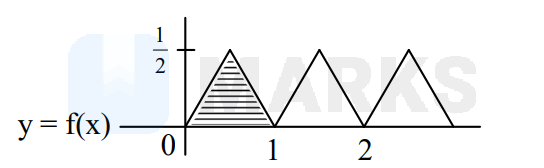
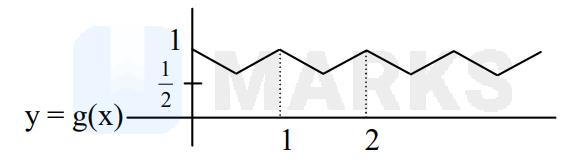
$\int_{0}^{\mathrm{n}} \mathrm{g}(\mathrm{x}) \mathrm{d} \mathrm{x}=\mathrm{n} \int_{0}^{1} \mathrm{~g}(\mathrm{x}) \mathrm{d} \mathrm{x}=\frac{3}{4} \mathrm{n} \quad \int_{0}^{\mathrm{n}} \mathrm{f}(\mathrm{x}) \mathrm{d} \mathrm{x}=\frac{\mathrm{n}}{4}$
Hence, the correct answer is option: 'C'.