Q9 / 180 · COMEDK 2024 (Memory Based) · Chemistry
Observe the given below reaction.
Aqueous $\mathrm{CuSO}_4 \xrightarrow{\text { Excess } a q \mathrm{KCN}} A \xrightarrow{\mathrm{H}_2 \mathrm{~S}} B$
A, B respectively are
Aqueous $\mathrm{CuSO}_4 \xrightarrow{\text { Excess } a q \mathrm{KCN}} A \xrightarrow{\mathrm{H}_2 \mathrm{~S}} B$
A, B respectively are
- Correct answerA$\mathrm{K}_3\left[\mathrm{Cu}(\mathrm{CN})_4\right]$, no precipitate
- B$\mathrm{K}_2\left[\mathrm{Cu}(\mathrm{CN})_4\right]$, no precipitate
- C$\mathrm{K}_4\left[\mathrm{Cu}(\mathrm{CN})_6\right]$, white ppt.
- D$\mathrm{K}_2\left[\mathrm{Cu}(\mathrm{CN})_4\right]$, black precipitate
Solution
The complete reaction is as follow.
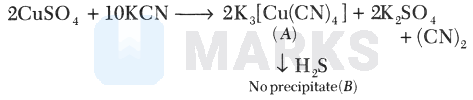
As $\mathrm{CN}^{-}$is a strong ligand, the complex formed is highly stable and does not dissociate to give $\mathrm{Cu}^{+}$ions. However, no precipitate of CuS is formed when $\mathrm{H}_2 \mathrm{~S}$ gas is passes through solution.
As $\mathrm{CN}^{-}$is a strong ligand, the complex formed is highly stable and does not dissociate to give $\mathrm{Cu}^{+}$ions. However, no precipitate of CuS is formed when $\mathrm{H}_2 \mathrm{~S}$ gas is passes through solution.
Hence, the correct answer is option: 'A'.