Q3 / 54 · JEE Advanced 2026 (Paper 2) · Chemistry
Natural rubber on complete ozonolysis ($\text{O}_3$/Zn-$\text{H}_2\text{O}$) gives compound $\textbf{X}$ as the major product. $\textbf{X}$ gives positive iodoform and Tollen's tests. $\textbf{X}$ on heating with aqueous NaOH gives $\textbf{Y}$ as the major product. $\textbf{Y}$ is
- Correct answerA
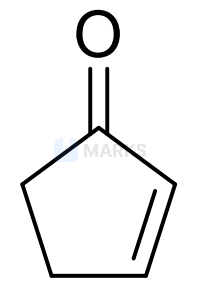
- B
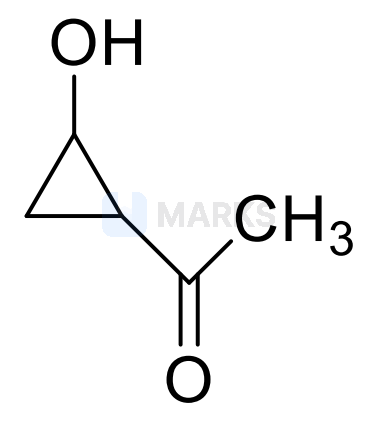
- C
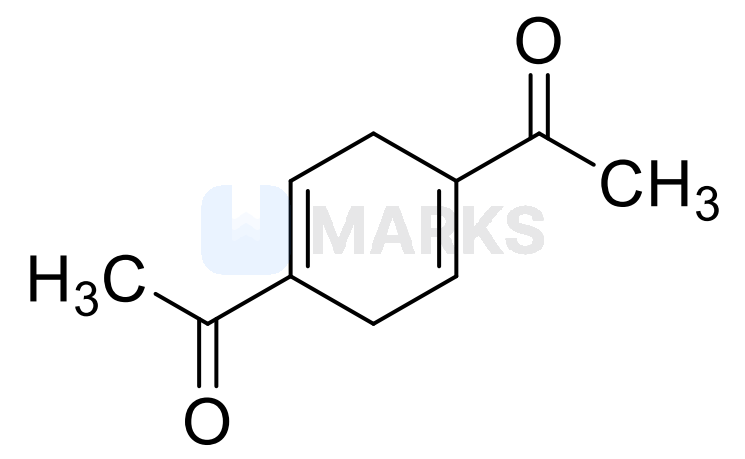
- D
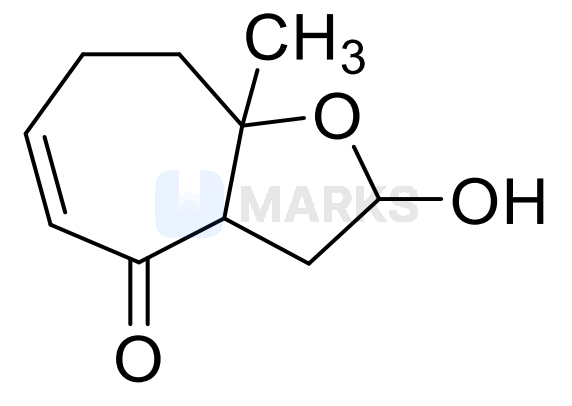
Solution
Natural rubber is cis-1,4-polyisoprene, with the repeating unit $[-\text{CH}_2-\text{C}(\text{CH}_3)=\text{CH}-\text{CH}_2-]_n$.
Complete reductive ozonolysis ($\text{O}_3$/Zn-$\text{H}_2\text{O}$) of natural rubber cleaves the double bonds to give 4-oxopentanal (levulinaldehyde) as compound X.
$[-\text{CH}_2-\text{C}(\text{CH}_3)=\text{CH}-\text{CH}_2-]_n \xrightarrow{\text{O}_3/\text{Zn-H}_2\text{O}} n \text{ CH}_3-\text{C}(=\text{O})-\text{CH}_2-\text{CH}_2-\text{CHO}$
Compound X ($\text{CH}_3-\text{CO}-\text{CH}_2-\text{CH}_2-\text{CHO}$) has a methyl ketone group, which gives a positive iodoform test, and an aldehyde group, which gives a positive Tollen's test.
When X is heated with aqueous NaOH, it undergoes an intramolecular aldol condensation. The base abstracts an $\alpha$-proton from the terminal methyl group to form an enolate, which then attacks the aldehyde carbonyl carbon to form a stable five-membered ring.
The intermediate formed is 3-hydroxycyclopentanone, which upon heating undergoes dehydration to yield cyclopent-2-en-1-one as the major product Y.
Answer:
Hence, the correct answer is option: 'A'.