Q20 / 55 · NEST (NISER) 2012 · Chemistry
Naphthalene $(\mathrm{X})$ is an aromatic compound and is the largest single component of coal tar.
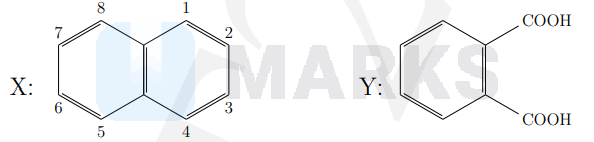
To prove the structure of naphthalene, Graebe (1869) carried out oxidation studies on it. X on oxidation gives phthalic acid $(\mathrm{Y})$. X can be shown as a resonance hybrid of three principal structures (assumed to be equally contributing). Given the bond lengths $(Ã…): \mathrm{C}_{\mathrm{sp}^3}-\mathrm{C}_{\mathrm{sp}^3}=1.54 ; \mathrm{C}_{\mathrm{sp}^3}-\mathrm{C}_{\mathrm{sp}^2}=1.50 ; \mathrm{C}_{\mathrm{sp}^2}-\mathrm{C}_{\mathrm{sp}^2}=1.48 ; \mathrm{C}_{\mathrm{sp}^2}=\mathrm{C}_{\mathrm{sp}^2}=1.34$, choose the correct statement(s) from the following.
To prove the structure of naphthalene, Graebe (1869) carried out oxidation studies on it. X on oxidation gives phthalic acid $(\mathrm{Y})$. X can be shown as a resonance hybrid of three principal structures (assumed to be equally contributing). Given the bond lengths $(Ã…): \mathrm{C}_{\mathrm{sp}^3}-\mathrm{C}_{\mathrm{sp}^3}=1.54 ; \mathrm{C}_{\mathrm{sp}^3}-\mathrm{C}_{\mathrm{sp}^2}=1.50 ; \mathrm{C}_{\mathrm{sp}^2}-\mathrm{C}_{\mathrm{sp}^2}=1.48 ; \mathrm{C}_{\mathrm{sp}^2}=\mathrm{C}_{\mathrm{sp}^2}=1.34$, choose the correct statement(s) from the following.
- Correct answerAThere are ten isomers of dichloronaphthalene.
- Correct answerB2-Nitronaphthalene on oxidation gives nitrophthalic acid, while 2-aminonaphthalene gives phthalic acid.
- CThe 1,2 -bond in naphthalene has a bond length of $1.39 Ã…$.
- Correct answerDComplete reduction of naphthalene gives decalin $\left(\mathrm{C}_{10} \mathrm{H}_{18}\right)$. There are two isomeric decalins.
Hence, the correct answer is options: 'A', 'B', 'D'.