Q40 / 60 · JEE Advanced 2011 (Paper 2) · Mathematics
Match the statements given in Column I with the intervals/union of intervals given in Column II.
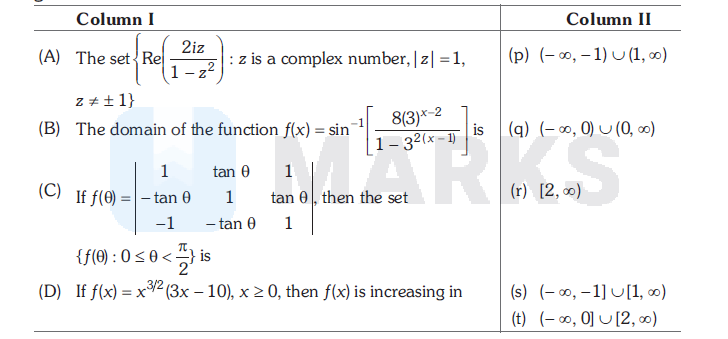
- A(A) q, (B) r, (C) s, (D) t
- B(A) s, (B) t, (C) r, (D) q
- C(A) q, (B) r, (C) s, (D) r
- Correct answerD(A) s, (B) t, (C) r, (D) r
Solution
(A) Given, $|z|=1 \Rightarrow z \cdot \bar{z}=1$
$$
\therefore \quad \frac{2 i z}{1-z^2}=\frac{2 i z}{z \cdot \bar{z}-z^2}=\frac{2 i}{\bar{z}-z} \text {, }
$$
Let $\quad z=x+i y$
$$
\therefore z-\bar{z}=2 i y=\frac{2 i}{-2 i y}=-\frac{1}{y}
$$
where, $y=\sqrt{1-x^2}$
$\therefore \quad-1 \leq y \leq 1 \Rightarrow-1 \leq y$
and $y \leq 1 \Rightarrow-1 \geq \frac{1}{y}$ and $\frac{1}{y} \geq 1$
$\Rightarrow \operatorname{Re}\left(\frac{2 i z}{1-z^2}\right) \in(-\infty,-1] \cup[1, \infty)$
(B) $f(x)=\sin ^{-1}\left(\frac{8\left(3^{x-2}\right)}{1-3^{2(x-1)}}\right)$,
$$
\begin{aligned}
& \text { For domain, }-1 \leq \frac{8\left(3^{x-2}\right)}{1-3^{2(x-1)}} \leq 1 \\
& \Rightarrow \quad-1 \leq \frac{9 \cdot\left(3^{x-2}\right)-\left(3^{x-2}\right)}{1-3^{2(x-1)}} \leq 1 \\
& \therefore \quad-1 \leq \frac{3^x-3^{x-2}}{1-3^x \cdot 3^{(x-2)}} \leq 1 \\
& \frac{3^x-3^{x-2}}{1-3^x \cdot 3^{x-2}} \geq-1 \\
& \Rightarrow \frac{\left(3^x-1\right)\left(3^{x-2}-1\right)}{\left(3^{x-1}+1\right)\left(3^{x-1}-1\right)} \geq 0 \\
& \Rightarrow \quad x \in(-\infty, 0] \cup(1, \infty) \\
& \text { and } \frac{3^x-3^{x-2}}{1-3^x \cdot 3^{x-2}} \leq 1 \\
& \Rightarrow \frac{\left(3^{x-2}-1\right)\left(3^x+1\right)}{\left(3^{x-1}+1\right)\left(3^{x-1}-1\right)} \geq 0 \\
&
\end{aligned}
$$

and $x \in(-\infty, 1) \cup[2, \infty)$ $\therefore \quad x \in(-\infty, 0] \cup[2, \infty)$ (C) $f(\theta)=\left|\begin{array}{ccc}1 & \tan \theta & 1 \\ -\tan \theta & 1 & \tan \theta \\ -1 & -\tan \theta & 1\end{array}\right|$ $$ \begin{aligned} R_1 & \rightarrow R_1+R_3, \\ f(\theta) & =\left|\begin{array}{ccc} 0 & 0 & 2 \\ -\tan \theta & 1 & \tan \theta \\ -1 & -\tan \theta & 1 \end{array}\right| \\ & =2\left(\tan ^2 \theta+1\right)=2 \sec ^2 \theta \geq 2 \\ f(\theta) & \in[2, \infty) \end{aligned} $$ $$ \text { (D) } \begin{aligned} f(x) & =x^{3 / 2}(3 x-10) ; x \geq 0 \\ f^{\prime}(x) & =x^{3 / 2} \cdot 3+\frac{3}{2} \cdot x^{1 / 2}(3 x-10) \\ & =3 x^{1 / 2}\left\{x+\frac{1}{2}(3 x-10)\right\} \end{aligned} $$ $$ \begin{aligned} & =\frac{3}{2} x^{1 / 2}\{2 x+3 x-10\} \\ & =\frac{15}{2} x^{1 / 2}(x-2) \\ & \\ \therefore \quad & x \geq 2 \end{aligned} $$
and $x \in(-\infty, 1) \cup[2, \infty)$ $\therefore \quad x \in(-\infty, 0] \cup[2, \infty)$ (C) $f(\theta)=\left|\begin{array}{ccc}1 & \tan \theta & 1 \\ -\tan \theta & 1 & \tan \theta \\ -1 & -\tan \theta & 1\end{array}\right|$ $$ \begin{aligned} R_1 & \rightarrow R_1+R_3, \\ f(\theta) & =\left|\begin{array}{ccc} 0 & 0 & 2 \\ -\tan \theta & 1 & \tan \theta \\ -1 & -\tan \theta & 1 \end{array}\right| \\ & =2\left(\tan ^2 \theta+1\right)=2 \sec ^2 \theta \geq 2 \\ f(\theta) & \in[2, \infty) \end{aligned} $$ $$ \text { (D) } \begin{aligned} f(x) & =x^{3 / 2}(3 x-10) ; x \geq 0 \\ f^{\prime}(x) & =x^{3 / 2} \cdot 3+\frac{3}{2} \cdot x^{1 / 2}(3 x-10) \\ & =3 x^{1 / 2}\left\{x+\frac{1}{2}(3 x-10)\right\} \end{aligned} $$ $$ \begin{aligned} & =\frac{3}{2} x^{1 / 2}\{2 x+3 x-10\} \\ & =\frac{15}{2} x^{1 / 2}(x-2) \\ & \\ \therefore \quad & x \geq 2 \end{aligned} $$
Hence, the correct answer is option: 'D'.