Q60 / 160 · TS EAMCET 2020 (11 Sep Shift 2) · Mathematics
Match the items of List-I with those of List-II
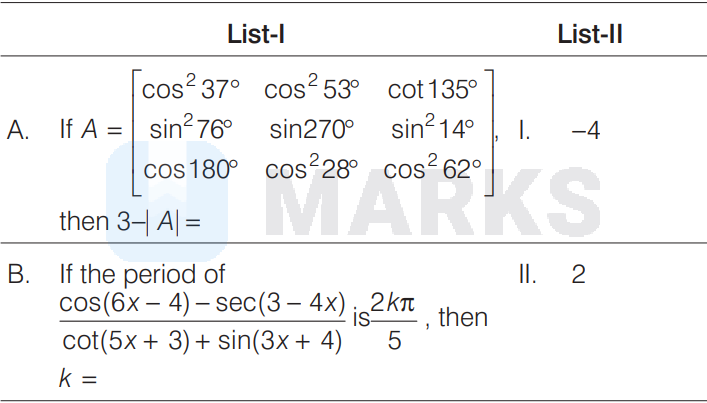
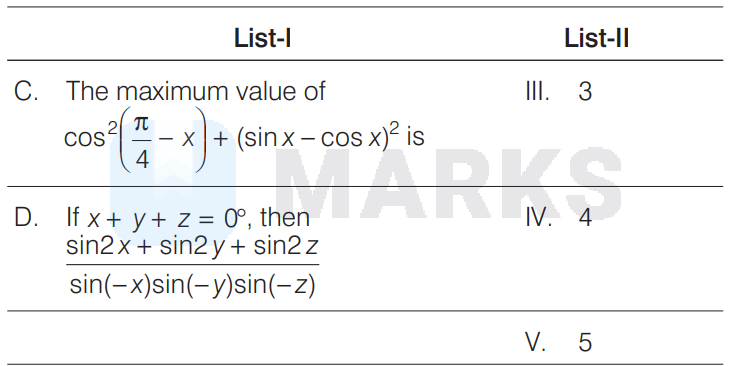
The correct match is
The correct match is
- Correct answerA
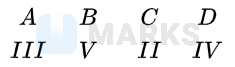
- B
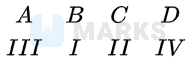
- C
- D
Solution
Given, $A=\left[\begin{array}{ccc}\cos ^2 37 & \cos ^2 53 & \cot 135 \\ \sin ^2 76 & \sin 270 & \sin ^2 14 \\ \cos 180 & \cos ^2 28 & \cos ^2 62\end{array}\right]$
$\therefore \quad A=\left[\begin{array}{ccc}\cos ^2 37 & \cos ^2 53 & -1 \\ \sin ^2 76 & -1 & \sin ^2 14 \\ -1 & \cos ^2 28 & \cos ^2 62\end{array}\right]$
$\therefore \quad|A|=\left|\begin{array}{ccc}\cos ^2 37 & \cos ^2 53 & -1 \\ \sin ^2 76 & -1 & \sin ^2 14 \\ -1 & \cos ^2 28 & \cos ^2 62\end{array}\right|$
Use $C_1 \rightarrow C_1+C_2$ and $C_2 \longrightarrow C_2+C_3$
$|A|=\left|\begin{array}{ccc}\cos ^2 37+\cos ^2 53 & \cos ^2 53-1 & -1 \\ \sin ^2 76-1 & -1+\sin ^2 14 & \sin ^2 14 \\ -1+\cos ^2 28 & \cos ^2 28+\cos ^2 62 & \cos ^2 62\end{array}\right|$
$|A|=\left|\begin{array}{ccc}1 & -\sin ^2 53 & -1 \\ -\cos ^2 76 & -\cos ^2 14 & \sin ^2 14 \\ -\sin ^2 28 & 1 & \cos ^2 62\end{array}\right|$
$|A|=-\left|\begin{array}{ccc}1 & -\sin ^2 53 & +1 \\ -\sin ^2 14 & -\cos ^2 14 & -\sin ^2 14 \\ -\cos ^2 62 & 1 & -\cos ^2 62\end{array}\right| \Rightarrow|A|=0$
Now $3-|A|=3$
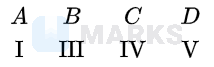
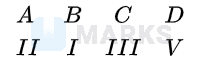
$\therefore \quad(\mathrm{A}) \rightarrow(\mathrm{iii})$
(B) Given $\frac{\cos (6 x-4)+\sec (3-4 x)}{\cot (5 x+3)+\sin (3 x+4)}$
$\therefore$ Period of $\cos (6 x-4)=\frac{2 \pi}{6}=\frac{\pi}{3}$
Period of $\sec (3-4 x)=\frac{2 \pi}{4}=\frac{\pi}{2}$
Period of $\cot (5 x+3)=\frac{\pi}{5}$
Period of $\sin (3 x+4)=\frac{2 \pi}{3}$
Now required period $=\lim$ of $\left(\frac{\pi}{3}, \frac{\pi}{2}, \frac{\pi}{5}, \frac{2 \pi}{3}\right)=2 \pi$
Now, given $\frac{2 k \pi}{5}=2 \pi \Rightarrow k=5$
$(\mathrm{B}) \rightarrow(\mathrm{v})$
(C) given $y=\cos ^2\left(\frac{\pi}{4}-x\right)+(\sin x-\cos x)^2$
$\therefore \quad y=\frac{1}{2}(\cos x+\sin x)^2+(\sin x-\cos x)^2$
$y=\frac{1}{2}(1+\sin 2 x)+(1-\sin 2 x) \Rightarrow y=\frac{3}{2}-\frac{\sin 2 x}{2}$
$\therefore y_{\max }$ when $\sin 2 x=-1 \quad \therefore \quad y_{\max }=\frac{3}{2}+\frac{1}{2}=2$
$(C) \rightarrow(\mathrm{ii})$
(D) It $x+y+z=0^{\circ}$
$\Rightarrow \sin 2 x+\sin 2 y+\sin 2 z=-4 \sin x \sin y \sin z$
Now, $\frac{\sin 2 x+\sin 2 y+\sin 2 z}{\sin (-x) \sin (-y) \sin (-z)}$
$\Rightarrow \frac{-4 \sin x \sin y \sin z}{-\sin x \sin y \sin z}=4$
$(\mathrm{D}) \rightarrow(\mathrm{iv})$
Hence, the correct answer is option: 'A'.