Q14 / 160 · AP EAMCET 2022 (07 Jul Shift 2) · Chemistry
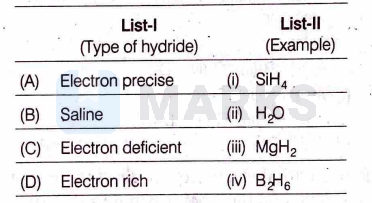
Match the following.
- AA-(ii); B-(iii); C-(i); D-(iv)
- Correct answerBA-(i); B-(iii); C-(iv); D-(ii)
- CA-(iv); B-(ii); C-(iii); D-(i)
- DA-(ii); B-(i); C-(iv); D-(iii)
Solution
(C) Electron precise hydrides have the exact number of electrons needed to form covalent bonds. These are formed by group 14 elements such as $\mathrm{CH}_4, \mathrm{SiH}_4$, etc. Therefore, $\mathrm{A}$ of list I matches with (i) of list II.
Saline hydrides (also known as ionic hydrides) are compounds form between hydrogen and the most active metals, especially with the alkali and alkaline-earth metals such as $\mathrm{MgH}_2$. Therefore, B of list I matches with (iii) of list II.
The compounds in which the central atom has an incomplete octet are called electron-deficient hydrides. Such as boron in $\mathrm{B}_2 \mathrm{H}_6$ has incomplete octet. Therefore, $\mathrm{C}$ of list I matches with (iv) of list II.
Electron rich hydrides These hydrides have one or more lone pairs of electrons around the central more electronegative element such as $\mathrm{H}_2 \mathrm{O}$. Therefore, D of list I matches with (ii) of list II.
Hence, the correct answer is option: 'B'.