Q157 / 200 · NEET 2023 (Manipur) · Zoology
Match List-I with List-II
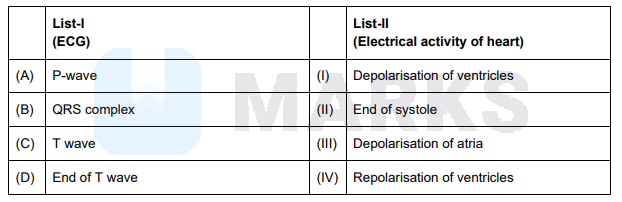
Choose the correct answer from the options given below :
Choose the correct answer from the options given below :
- A$(\mathrm{A})-(\mathrm{IV}),(\mathrm{B})-(\mathrm{III}),(\mathrm{C})-(\mathrm{I}),(\mathrm{D})-(\mathrm{II})$
- Correct answerB$(\mathrm{A})-(\mathrm{III}),(\mathrm{B})-(\mathrm{I}),(\mathrm{C})-(\mathrm{IV}),(\mathrm{D})-(\mathrm{II})$
- C$(\mathrm{A})-(\mathrm{IV}),(\mathrm{B})-(\mathrm{I}),(\mathrm{C})-(\mathrm{III}),(\mathrm{D})-(\mathrm{II})$
- D$(\mathrm{A})-(\mathrm{I}),(\mathrm{B})-(\mathrm{IV}),(\mathrm{C})-(\mathrm{III}),(\mathrm{D})-(\mathrm{II})$
Solution
Option (2) is the answer because, the P-wave represents the electrical excitation (depolarisation) of the atria which leads to the contraction of both the atria. The QRS complex represents the depolarisation of the ventricles. The T-wave represents the return of the ventricles from excited to normal state (Repolarisation). The end of the T-wave marks the end of systole.
Hence, the correct answer is option: 'B'.