Q107 / 240 · KCET 2026 · Chemistry
Match List-I with List-II and select the correct options
List-I (Functional group) List-II (Functional group reagent) (a) 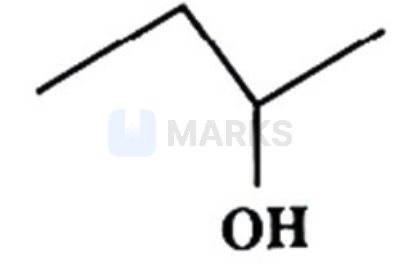
(i) Neutral ferric chloride test (b) $\text{C}_6\text{H}_5\text{NH}_2$ (ii) Azo dye test (c) $\text{CH}_3\text{CH}_2\text{CHO}$ (iii) Ceric ammonium nitrate test (d) 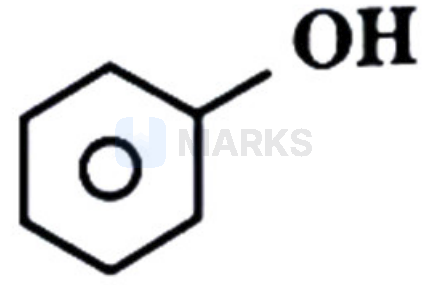
(iv) Tollen's reagent test
Codes:
| List-I (Functional group) | List-II (Functional group reagent) | ||
|---|---|---|---|
| (a) | | (i) | Neutral ferric chloride test |
| (b) | $\text{C}_6\text{H}_5\text{NH}_2$ | (ii) | Azo dye test |
| (c) | $\text{CH}_3\text{CH}_2\text{CHO}$ | (iii) | Ceric ammonium nitrate test |
| (d) | | (iv) | Tollen's reagent test |
- Aa-iv, b-i, c-ii, d–iii
- Correct answerBa-iii, b-ii, c-iv, d–i
- Ca-iii, b-ii, c-i, d–iv
- Da-ii, b-iii, c-iv, d–i
Solution
(a) The first compound is 2-butanol, which is an aliphatic alcohol. Aliphatic alcohols give a positive ceric ammonium nitrate test, producing a red colouration. Thus, (a) matches with (iii).
(b) $\text{C}_6\text{H}_5\text{NH}_2$ is aniline, a primary aromatic amine. It gives a positive azo dye test by reacting with nitrous acid to form a diazonium salt, which couples with $\beta$-naphthol to form an orange-red dye. Thus, (b) matches with (ii).
(c) $\text{CH}_3\text{CH}_2\text{CHO}$ is propanal, an aldehyde. Aldehydes reduce Tollen's reagent to form a silver mirror. Thus, (c) matches with (iv).
(d) The second compound is phenol. Phenols react with neutral $\text{FeCl}_3$ solution to give a characteristic violet colouration. Thus, (d) matches with (i).
The correct matching is a-iii, b-ii, c-iv, d-i.
Answer: a-iii, b-ii, c-iv, d–i
Hence, the correct answer is option: 'B'.