Q71 / 180 · KCET 2011 · Mathematics
Locus of a point which moves such that its distance from the $x$-axis is twice its distance from the line $x-y=0$ is
- A$x^{2}+4 x y-y^{2}=0$
- Correct answerB$2 x^{2}-4 x y+y^{2}=0$
- C$x^{2}-4 x y+y^{2}=0$
- D$x^{2}-4 x y-y^{2}=0$
Solution
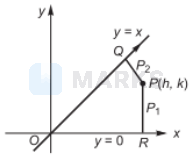
$P_{1}=$ length of perpendicular from $P$ to $x$-axis.
$P_{2}=$ length of perpendicular from $P$ to $y=x$ line.
$$
\begin{aligned}
P_{1} &=2 P_{2} \\
|k| &=2 \cdot \frac{|h-k|}{\sqrt{2}}
\end{aligned}
$$
Squaring on both sides,
$$
k^{2}=2(h-k)^{2}
$$
$$ \begin{array}{r} k^{2}=2 h^{2}+2 k^{2}-4 h k \\ \Rightarrow \quad 2 h^{2}-4 h k+k^{2}=0 \end{array} $$ So, the locus of a point $P$ is, $$ 2 x^{2}-4 x y+y^{2}=0 $$
$$ \begin{array}{r} k^{2}=2 h^{2}+2 k^{2}-4 h k \\ \Rightarrow \quad 2 h^{2}-4 h k+k^{2}=0 \end{array} $$ So, the locus of a point $P$ is, $$ 2 x^{2}-4 x y+y^{2}=0 $$
Hence, the correct answer is option: 'B'.