Q45 / 48 · JEE Advanced 2026 (Paper 1) · Physics
List-I shows four configurations made of straight and semi-circular narrow tubes containing air. A sound wave of wavelength $\lambda = 0.29$ m enters these structures at the point $S$ and a sound detector is placed at $D$. Between the points $S$ and $D$, the sound travels only through the tubes. List-II contains the possible smallest values of $l$ (refer to the figures) for which the detector $D$ records maximum amplitude. Ignore effects of sharp corners. [Given $\cos(15^\circ) = 0.97$]
Choose the option that best describes the match between the entries in List-I to those in List-II.
List-I List-II (P) 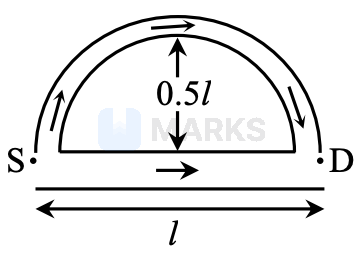
(1) $1.32$ m (Q) 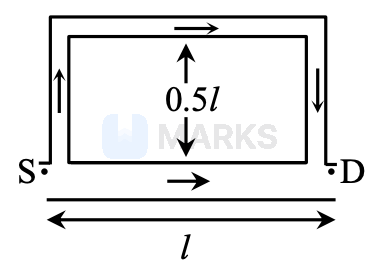
(2) $1.19$ m (R) 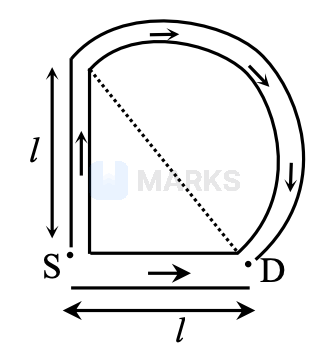
(3) $0.51$ m (S) 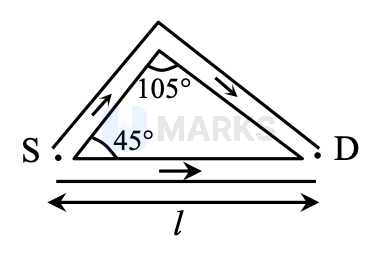
(4) $0.29$ m (5) $0.13$ m
Choose the option that best describes the match between the entries in List-I to those in List-II.
| List-I | List-II |
|---|---|
| (P) | (1) $1.32$ m |
| (Q) | (2) $1.19$ m |
| (R) | (3) $0.51$ m |
| (S) | (4) $0.29$ m |
| (5) $0.13$ m |
- AP$\rightarrow$4, Q$\rightarrow$3, R$\rightarrow$5, S$\rightarrow$1
- BP$\rightarrow$4, Q$\rightarrow$3, R$\rightarrow$1, S$\rightarrow$5
- CP$\rightarrow$3, Q$\rightarrow$4, R$\rightarrow$1, S$\rightarrow$2
- Correct answerDP$\rightarrow$3, Q$\rightarrow$4, R$\rightarrow$5, S$\rightarrow$2
Solution
For maximum amplitude at the detector $D$, the path difference $\Delta x$ between the two paths must be an integer multiple of the wavelength $\lambda$. For the smallest value of $l$, we take $\Delta x = \lambda = 0.29$ m.
For configuration (P):
The sound travels through a straight tube of length $l$ and a semi-circular tube of diameter $l$.
Path difference $\Delta x = \dfrac{\pi l}{2} - l = l\left(\dfrac{\pi}{2} - 1\right)$.
Equating to $\lambda$: $l\left(\dfrac{3.1416}{2} - 1\right) = 0.29 \Rightarrow l(0.5708) = 0.29 \Rightarrow l \approx 0.51$ m.
Thus, P $\rightarrow$ 3.
For configuration (Q):
The sound travels through a straight tube of length $l$ and a rectangular path of length $0.5l + l + 0.5l = 2l$.
Path difference $\Delta x = 2l - l = l$.
Equating to $\lambda$: $l = 0.29$ m.
Thus, Q $\rightarrow$ 4.
For configuration (R):
The sound travels through a straight horizontal tube of length $l$ and a path consisting of a vertical tube of length $l$ followed by a semi-circular tube.
The diameter of the semi-circle is the hypotenuse of the right triangle formed by the tubes, which is $\sqrt{l^2 + l^2} = l\sqrt{2}$.
The length of the semi-circular part is $\dfrac{\pi (l\sqrt{2})}{2} = \dfrac{\pi l}{\sqrt{2}}$.
Path difference $\Delta x = \left(l + \dfrac{\pi l}{\sqrt{2}}\right) - l = \dfrac{\pi l}{\sqrt{2}}$.
Equating to $\lambda$: $\dfrac{\pi l}{\sqrt{2}} = 0.29 \Rightarrow l = \dfrac{0.29 \sqrt{2}}{\pi} \approx \dfrac{0.29 \times 1.414}{3.1416} \approx 0.13$ m.
Thus, R $\rightarrow$ 5.
For configuration (S):
The sound travels through a straight tube of length $l$ and a triangular path.
The angles of the triangle are $45^\circ$, $105^\circ$, and $180^\circ - (45^\circ + 105^\circ) = 30^\circ$.
Using the sine rule, the lengths of the other two sides are $l \dfrac{\sin 30^\circ}{\sin 105^\circ}$ and $l \dfrac{\sin 45^\circ}{\sin 105^\circ}$.
Path difference $\Delta x = l \dfrac{\sin 30^\circ + \sin 45^\circ}{\sin 105^\circ} - l$.
Given $\sin 105^\circ = \cos 15^\circ = 0.97$.
$\Delta x = l \left( \dfrac{0.5 + 1/\sqrt{2}}{0.97} - 1 \right) \approx l \left( \dfrac{0.5 + 0.707}{0.97} - 1 \right) = l \left( \dfrac{1.207}{0.97} - 1 \right) \approx 0.244 l$.
Equating to $\lambda$: $0.244 l = 0.29 \Rightarrow l \approx 1.19$ m.
Thus, S $\rightarrow$ 2.
Matching the results, we get P $\rightarrow$ 3, Q $\rightarrow$ 4, R $\rightarrow$ 5, S $\rightarrow$ 2.
Answer: P$\rightarrow$3, Q$\rightarrow$4, R$\rightarrow$5, S$\rightarrow$2
Hence, the correct answer is option: 'D'.