Q67 / 75 · JEE Main 2026 (08 April Shift 2) · Physics
Light ray incident along a vector $\vec{AO}$ $(\vec{AO} = 2\hat{i}-3\hat{j})$ emerges out along vector $\vec{OB}$ $(\vec{OB} = C\hat{i}-4\hat{j})$ as shown in the figure below. The value of $C$ is ________.
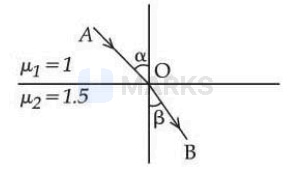
- Correct answerA$1.6$
- B$0.16$
- C$11.6$
- D$16$
Solution
From the given figure, the interface is horizontal and the normal is along the y-axis.
The incident ray is along the vector $\vec{AO} = 2\hat{i} - 3\hat{j}$.
The angle of incidence $\alpha$ is the angle between the incident ray and the normal.
$\sin \alpha = \dfrac{2}{\sqrt{2^2 + (-3)^2}} = \dfrac{2}{\sqrt{13}}$
The refracted ray is along the vector $\vec{OB} = C\hat{i} - 4\hat{j}$.
The angle of refraction $\beta$ is the angle between the refracted ray and the normal.
$\sin \beta = \dfrac{C}{\sqrt{C^2 + (-4)^2}} = \dfrac{C}{\sqrt{C^2 + 16}}$
Applying Snell's law at the interface:
$\mu_1 \sin \alpha = \mu_2 \sin \beta$
$1 \times \dfrac{2}{\sqrt{13}} = 1.5 \times \dfrac{C}{\sqrt{C^2 + 16}}$
$\dfrac{2}{\sqrt{13}} = \dfrac{3}{2} \dfrac{C}{\sqrt{C^2 + 16}}$
Squaring both sides:
$\dfrac{4}{13} = \dfrac{9}{4} \left( \dfrac{C^2}{C^2 + 16} \right)$
$16(C^2 + 16) = 117 C^2$
$16 C^2 + 256 = 117 C^2$
$101 C^2 = 256$
$C^2 = \dfrac{256}{101}$
$C = \dfrac{16}{\sqrt{101}} \approx 1.592$
Approximating $\sqrt{101} \approx 10$, we get $C \approx 1.6$.
Answer: $1.6$
Hence, the correct answer is option: 'A'.