Q38 / 90 · JEE Main 2021 (17 Mar Shift 2) · Mathematics
Let and be three sets defined as
and
Then, the set
Let and be three sets defined as
and
Then, the set
- Ais a singleton
- Bhas exactly two elements
- Correct answerChas infinitely many elements
- Dhas exactly three elements
Solution
We know that the complex number satisfying represents a circle with centre and radius units.
Hence, for lies on and inside the circle
of radius units and centre
For let
Now,
And, for again let
Plotting all the inequalities on the graph, we get
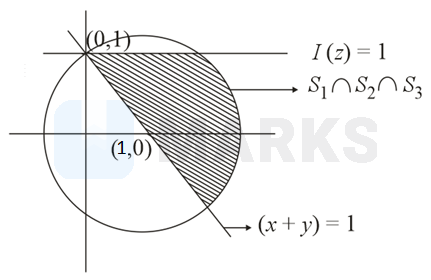
Now, the common part is shown in the shaded part, hence, we get infinite points in the shaded region.
has infinitely many elements.
Hence, the correct answer is option: 'C'.