Q24 / 51 · JEE Advanced 2024 (Paper 1) · Mathematics
Let $\mathbb{R}^3$ denote the three-dimensional space. Take two points $P=(1,2,3)$ and $Q=(4,2,7)$. Let $\operatorname{dist}(X, Y)$ denote the distance between two points $X$ and $Y$ in $\mathbb{R}^3$. Let
$\begin{gathered}S=\left\{X \in \mathbb{R}^3:(\operatorname{dist}(X, P))^2-(\operatorname{dist}(X, Q))^2=50\right\} \text { and } \\T=\left\{Y \in \mathbb{R}^3:(\operatorname{dist}(Y, Q))^2-(\operatorname{dist}(Y, P))^2=50\right\} .\end{gathered}$
Then which of the following statements is (are) TRUE?
- Correct answerAThere is a triangle whose area is 1 and all of whose vertices are from $S$.
- Correct answerBThere are two distinct points $L$ and $M$ in $T$ such that each point on the line segment $L M$ is also in $T$.
- Correct answerCThere are infinitely many rectangles of perimeter 48 , two of whose vertices are from $S$ and the other two vertices are from $T$.
- Correct answerDThere is a square of perimeter 48 , two of whose vertices are from $S$ and the other two vertices are from $T$.
Solution
$\begin{aligned}& \mathrm{S}=\left\{\mathrm{X}:(\mathrm{XP})^2-(\mathrm{XQ})^2=50\right\} \\& \mathrm{T}=\left\{\mathrm{Y}:(\mathrm{YQ})^2-(\mathrm{YP})^2=50\right\}\end{aligned}$
for finding $S \equiv X(x, y, z)$ and for $T \equiv Y(x, y, z)$
$\begin{aligned}&\left((x-1)^2+(y-1)^2+(\mathrm{z}-1)^2\right)-\left((\mathrm{x}-4)^2+(\mathrm{y}-2)^2+(\mathrm{z}-7)^2\right)=50 \\& \Rightarrow \quad \mathrm{S}=\{(\mathrm{x}, \mathrm{y}, \mathrm{z}): 6 \mathrm{x}+8 \mathrm{z}=105\} \\& \mathrm{T}=\{(\mathrm{x}, \mathrm{y}, \mathrm{z}): 6 \mathrm{x}+8 \mathrm{z}=5\}\end{aligned}$
Since $\mathrm{S}$ and $\mathrm{T}$ both are plane ;
(1) There exist a triangle in plane $\mathrm{S}$ whose area $=1$ (always)
(2) $\mathrm{L} ~\&~ \mathrm{M}$ lies on plane $\mathrm{T}$, hence line segment joining $\mathrm{L} \& \mathrm{M}$ will lie on plane $\mathrm{T}$.
(3) Distance between $\mathrm{S} \& \mathrm{~T}$
$\mathrm{d}=\left|\frac{105-5}{10}\right|=10$
Hence for rectangle of perimeter 48 can exist.
(4) For Square
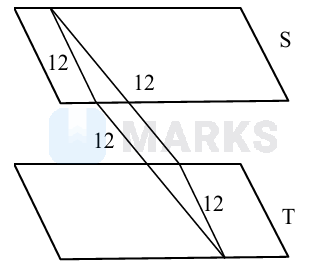 There will be infinite such rectangle possible.
Hence Answers 1,2,3,4 are correct.
There will be infinite such rectangle possible.
Hence Answers 1,2,3,4 are correct.Hence, the correct answer is options: 'A', 'B', 'C', 'D'.