Q98 / 160 · AP EAMCET 2022 (08 Jul Shift 2) · Mathematics
Let $\pi$ be the plane passing through the point $(3,-3,1)$ and perpendicular to the line joining the points $(3,4,-1)$ and $(2,-1,5)$. If the equation of the plane containing the points $(3,4,-1),(-1,2,5)$ and perpendicular to the plane $\pi$ is $a x+y+c z-d=0$, then $3(a+c)=$
- A$-d$
- B$2 d$
- Correct answerC$d$
- D$-2 d$
Solution
Plane $\pi$ passes through $(3,-3,1)$ and perpendicular to the line joining the points $(3,4,-1)$ and $(2,-1,5)$.
$\therefore \mathrm{DR}$ 's of normal to the plane are
$(3-2),(4,+1),(-1-5)$
$\equiv(1,5,-6)$
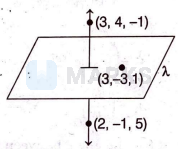
Equation of plane $\pi$ is given by $x+5 y-6 z+d=0$ $\because \pi$ consists the point $(3,-3,1)$. $\begin{array}{ll}\Rightarrow & 3-15-6+d=0 \Rightarrow d=18 \\ \therefore & \pi \equiv x+5 y-6 z+18=0\end{array}$ Equation of plane containing points $(3,4,-1)$ and $(-1,2,5)$ is $a x+y+c z-d=0$...(i)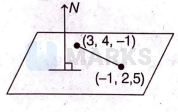
Normal to this plane will be perpendicular to the line joining the points $(3,4,-1)$ and $(-1,2,5)$. Then, $a(3+1)+1(4-2)+c(-1-5)=0$ $\Rightarrow \quad 4 a+2-6 c=0$ $\Rightarrow \quad 2 a+1-3 c=0$....(ii) Also, planes $\pi$ and Eq. (i) are perpendicular. $\Rightarrow \quad a+5-6 c=0$ $\Rightarrow \quad a=6 c-5$...(iii) On putting $a=6 c-5$ in Eq. (ii), $2(6 c-5)+1-3 c=0$ $\Rightarrow \quad 12 c-10+1-3 c=0$ $\Rightarrow \quad 9 c=9$ $\Rightarrow \quad c=1$ On putting $c=1$ in Eq. (iii), $a=6-5=1$ Thus, $a=c=1$ On putting $a=c=1$ in Eq. (i), $x+y+z-d=0$ This plane passes through $(-1,2,5)$ $\begin{array}{ll}\Rightarrow & -1+2+5-d=0 \\ \Rightarrow & d=6\end{array}$ Now, $3(a+c)$ $=3(1+1)=3 \times 2=6$ $\therefore \quad 3(a+c)=d$
Equation of plane $\pi$ is given by $x+5 y-6 z+d=0$ $\because \pi$ consists the point $(3,-3,1)$. $\begin{array}{ll}\Rightarrow & 3-15-6+d=0 \Rightarrow d=18 \\ \therefore & \pi \equiv x+5 y-6 z+18=0\end{array}$ Equation of plane containing points $(3,4,-1)$ and $(-1,2,5)$ is $a x+y+c z-d=0$...(i)
Normal to this plane will be perpendicular to the line joining the points $(3,4,-1)$ and $(-1,2,5)$. Then, $a(3+1)+1(4-2)+c(-1-5)=0$ $\Rightarrow \quad 4 a+2-6 c=0$ $\Rightarrow \quad 2 a+1-3 c=0$....(ii) Also, planes $\pi$ and Eq. (i) are perpendicular. $\Rightarrow \quad a+5-6 c=0$ $\Rightarrow \quad a=6 c-5$...(iii) On putting $a=6 c-5$ in Eq. (ii), $2(6 c-5)+1-3 c=0$ $\Rightarrow \quad 12 c-10+1-3 c=0$ $\Rightarrow \quad 9 c=9$ $\Rightarrow \quad c=1$ On putting $c=1$ in Eq. (iii), $a=6-5=1$ Thus, $a=c=1$ On putting $a=c=1$ in Eq. (i), $x+y+z-d=0$ This plane passes through $(-1,2,5)$ $\begin{array}{ll}\Rightarrow & -1+2+5-d=0 \\ \Rightarrow & d=6\end{array}$ Now, $3(a+c)$ $=3(1+1)=3 \times 2=6$ $\therefore \quad 3(a+c)=d$
Hence, the correct answer is option: 'C'.