Q37 / 75 · JEE Main 2025 (22 Jan Shift 1) · Mathematics
Let $f: \mathbf{R} \rightarrow \mathbf{R}$ be a twice differentiable function such that $f(x+y)=f(x) f(y)$ for all $x, y \in \mathbf{R}$. If $f^{\prime}(0)=4 \mathrm{a}$ and $f$ satisfies $f^{\prime \prime}(x)-3 \mathrm{a} f^{\prime}(x)-f(x)=0$, $\mathrm{a}\gt0$, then the area of the region $\mathrm{R}=\{(x, y) \mid 0 \leq y \leq f(\mathrm{a} x), 0 \leq x \leq 2\}$ is:
- Correct answerA$e^2-1$
- B$\mathrm{e}^2+1$
- C$e^4+1$
- D$e^4-1$
Solution
$\begin{aligned}
& f(x+y)=f(x) \cdot f(y) \\
& \Rightarrow f(x)=e^{\lambda x} f^{\prime}(0)=4 a \\
& \Rightarrow f^{\prime}(x)=\lambda e^{\lambda x} \Rightarrow \lambda=4 a
\end{aligned}$
So, $f(x)=e^{4 x}$
$\begin{aligned}
& \mathrm{f}^{\prime \prime}(\mathrm{x})-3 \mathrm{af}{ }^{\prime}(\mathrm{x})-\mathrm{f}(\mathrm{x})=0 \\
& \Rightarrow \lambda^2-3 \mathrm{a} \lambda-1=0 \\
& \Rightarrow 16 \mathrm{a}^2-12 \mathrm{a}^2-1=0 \Rightarrow 4 \mathrm{a}^2=1 \Rightarrow \mathrm{a}=\frac{1}{2}
\end{aligned}$
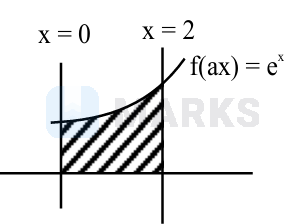
$\begin{aligned} & \mathrm{F}(\mathrm{x})=\mathrm{e}^{2 \mathrm{x}} \\ & \text { Area }=\int_0^2 \mathrm{e}^{\mathrm{x}} \mathrm{dx}=\mathrm{e}^2-1\end{aligned}$
$\begin{aligned} & \mathrm{F}(\mathrm{x})=\mathrm{e}^{2 \mathrm{x}} \\ & \text { Area }=\int_0^2 \mathrm{e}^{\mathrm{x}} \mathrm{dx}=\mathrm{e}^2-1\end{aligned}$
Hence, the correct answer is option: 'A'.